Ever present cell phones have allowed all to capture the minutia of their lives via pics and Shakey-hand movies. on occasion marvelous things have been captured. The more present negative is that people have forgotten how to look at paintings.
A “good” painting now must be in the real/hyper real style, being comparable to photos. It is not desirable to see the artist’s hand via brush strokes et al in a work.
I was in a museum which was having a Magritte show. There were the by now all overly familiar images on display. People would walk up to the best works, striding off muttering in disappointment that they liked it more when they had seen it on a computer screen or postcard, in person it looked “too homemade” i.e. brushstrokes etc.
I am not afraid of having one of my drawings look like a drawing or a painting. With Matisse for example, no one is going to study anatomy off of one of his works. However, when he portrays a woman reclining on a couch, you know what you are looking at. Had you been alive at that time and in the neighborhood you might even recognize the woman. Most importantly, even after all these decades, the captured emotion still radiates out of the works.
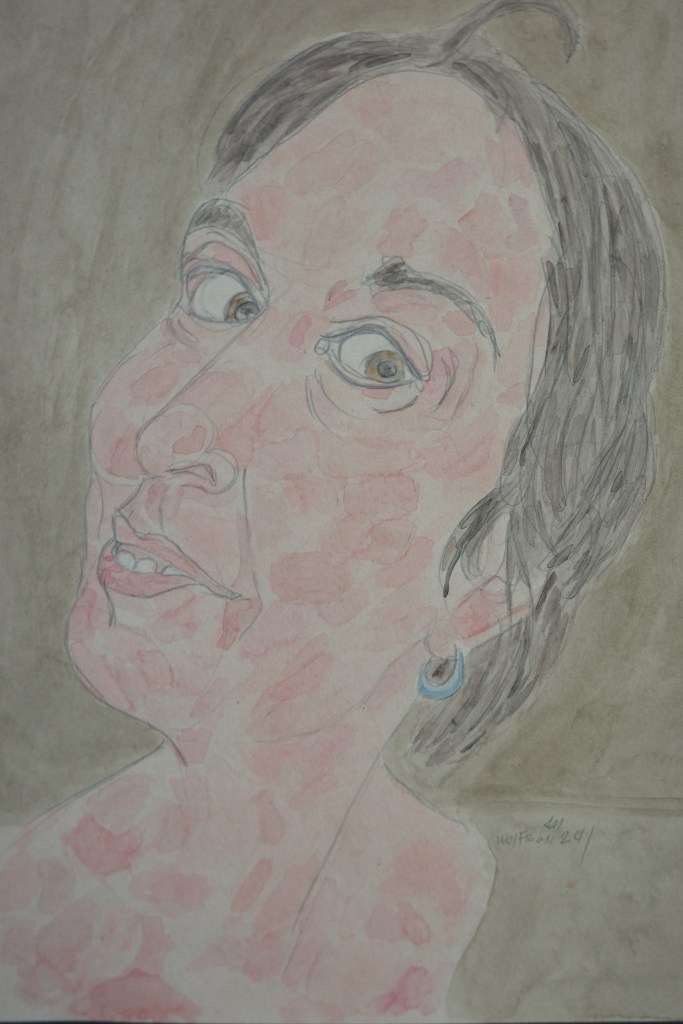
I prefer to not use professional models. There’s often an artificiality to their poses. My main thing is emotion, this is what I want to give the viewer even more than admiring technique.
More often than not, I use people whom i know and that trust me. This allows for a realness which is beautiful. The realness of my paintings is not the technique but the natural poses and emotions.
Truth is Beauty 11×17 Watercolor on tan paper


 Paper Life Painting
I prefer to see the brushstrokes in the art work every time.
LikeLiked by 2 people
Me too, it’s part of a painter’s voice
LikeLiked by 1 person
Wonderful painting! I love how you paint the skin.
LikeLiked by 2 people
Thank you!
LikeLike
Interesting share. I didn’t know there was a perspective that people don’t like seeing the more physical components of a painting but prefer something that’s more like photo.
Personally, I like seeing the brushwork and the more emotive interpretations of an artist like Matisse. I think one of the downsides to technology and online viewing of artwork is the disconnect of being able to experience a piece in its entirety.
LikeLiked by 2 people
Exactly. Brushwork of a master is an amazing thing to behold.
LikeLike
Well painted!👍👍
LikeLiked by 2 people
Thank you
LikeLiked by 2 people
😊
LikeLiked by 1 person
So much more than a photo. This shares emotion through your drawings.
LikeLiked by 2 people
Thank you
LikeLiked by 1 person