Hot House

People have forgotten how to look at figurative art.

This largely is on account of the always present phones in our lives. Ever present and ever ready to capture whatever we deem important or interesting. The ability to now document the minutia of our lives has made it so that the “merely” representational images seem “off”, wrong or not impressive, so used to the availability of actual photos have we become.

Now, if you draw a person, it needs to be hyper real to be appreciated by the casual art peruser.

It is all right for a portrait to look like the subject but also like a painting/drawing.

We treasure the paintings of Matisse and while when he portrays a woman on a couch we know what we are seeing, no one is going to ever use it to do a technical anatomical study from. The emotion resonating from his work not technical portrayal is where the joy is to be found.

Another aspect which seems largely forgotten are the dynamics between artist & model. While most artists want to convey the likeness of their subject, ultimately it is as if the artist is describing the model using their words, words in this case being their style (technique).

A final important component in portraying a subject is that none of us look the same all the time. Mood, health, ambient surroundings all dictates changes on our faces, bodies and even body language.

I often use same people over the course of many works, each time there are little differences. This is not imperfection of technique nor chops operating only at a certain skill level.

Doing it right, a series of pieces using same subject is not dissimilar to Bird & Diz riffing off of Hot House. The basic structure remains familiar but with changes built off the initial theme, always slightly different but containing recognizable components.


Here is informal series I did. I never think of what I want to portray, I just execute what I see without agenda. After the first piece, this series showed a playfulness along with a bemused surprise at a until then, thought secret vulnerability.

Music Addict Paris ’18


Simmer D 2

Fairly soon after the selfie became part of North Americas’ cultural heritage (along w/Netflix) word spread from those “in the know” of the ideal position of the camera for a selfie (slightly diagonally above the head angled down from the left).

Social media and personal pages are now a glut of girls & women falling between specific ages regularly posting photos, bodies semi twisted to the side, camera in the now familiar angle, mouth forming the assumed to be sexy duckbill.

There is now the male equivalent of “the pose”

I was watching television. An I-Phone commercial came on. It showed a young collegiate in shorts on break at a beach. He went to take a selfie w/the surf at his back. He tilted his head to the left and partially opened his mouth in the manner of the beginning of a smile. (he might have also given a thumbs up, if he didn’t literally you got the feeling he meant to)

The show merely worthy of folding laundry to came back on.

The next commercial was a fit middle aged man w/silver hair . The advertisement was for a travel service where you can compare hotel rates and do specific search comparisons (i.e with a pool et al).

He then went on to say that it was how he found his great room w/an ocean view. A blue screened view was behind him as he raised his phone tilted his head sideways and half opened his mouth, start of smile, thumbs up and click.

What had been “ideal” poses are now hackneyed and overdone. While technically it may still help hide the start of a second chin or other imperfections that can’t be wished away, there is a sameness to all these images which renders them devoid of any flavor and personality.

We can now laugh or roll our eyes at the overly familiar poses. It will never go away though. It has become the standard.

Figurative art has its own version of these phenomenons.

Whether it is painting or drawing, i like to use amateurs as much as possible. The main reason for this is their manner of posing. I want natural body language. Emotion is the most important aspect of my work and the first step in achieving this is  honesty.

When faced with the task of posing for an artistic picture, what can rob it of its power is the subject striking a glamor or traditional pose. The traditional figure poses are still utilized in schools and classes. No matter how good the painter, it will always give the work an academic air which robs it of really compelling the viewer.

Glamor poses by their very nature have an artificiality that is to emotions what porn is to romance.

The pose of the subject also effects the composition of a work.

I reject the academic but also (sometimes) the “correct” compositional lay out of what the viewer sees where.

I like to think that most of my work conveys the feeling that the viewer is seeing a part of a story or a small self contained story. Some of the odd angles and unorthodox compositional balance bolsters tension & emotion facilitating this.

In real life when looking at someone, whether it is one table over in a cafe or laying on a couch, we do not necessarily see all of them or all of them in proportion.

To some who have formally studied or taken classes, unless doing a specific exercise it may seem awkward or counter intuitive  but it is well worth finding new ways to visually tell the story of a subject’s body besides the tried & true.


“Simmer D 2” watercolor & Paper 5.5×8.5


SimerD2


The Stripes Are Black

Watercolor & Cotton Paper 7×10

When I initially started doing portraits I would paint whatever was going on in the background of the subject, the room. While I still do that sometimes, at others I reduce it down. The mattress/bed etc will just become the color of the sheet or the wallpaper.

My choice of color in these situations is whatever the actual color is as I feel it part of the story I am portraying. Green wall w/bookcases or whatnot becomes green square in which the subject is enmeshed, all other objects dropped away.


The stripes in this piece matching up w/the shirt was not a contrivance but lucky happanstance. I did change their color from black to blue as I felt the black gave it an air of :

I have compositional weakness and so inserted stripes to help fill up space.


Others might not have thought/felt this, who knows.


With my drawings I still mostly portray what else is going on besides the subject. Paintings it is a piece by piece basis.


Cuba

Watercolor & paper 5.5×8.5


The best artwork in any medium we can return to over and over again. We find new aspects revealed in it.

The work seems to, with the passage of time change. It is not the work which is ever in flux but ourselves. Better works have multiple layers of enjoyment  and so seemingly keep up with us on the evolutionary journey of intellect/taste/spirit.

With my work, this is why my main goal and raison d’e tre is conveying emotion. No matter what the social mores or trends are, we all will continue to feel sorrow & ecstasy.


Cuba


Piece # 3

9×12 Watercolor & Paper

This piece was done on Canson mix media paper 98LB

It was the third in a series with this model.

With all my portraiture, I always want an organic feel which starts first with the subject.

In lieu of the academic or glam poses, I want the subject’s natural body language to come through. This honesty makes for a conveying of emotion which is the most important aspect of all my works.

I never choreograph a pose, my only input having to do with if I feel the light is not hitting the subject evenly.

This paper, although intended for among other mediums, watercolors, requires a different touch than any of the other types of paper I use for my painting. It is harder to use, which is why I like it. If I can achieve the desired effects with this paper, then when using my ideal (paper), it is far easier.

These little self challenges are one of the ways I foster evolution in my art and avoid lapsing into mannerisms.piece3


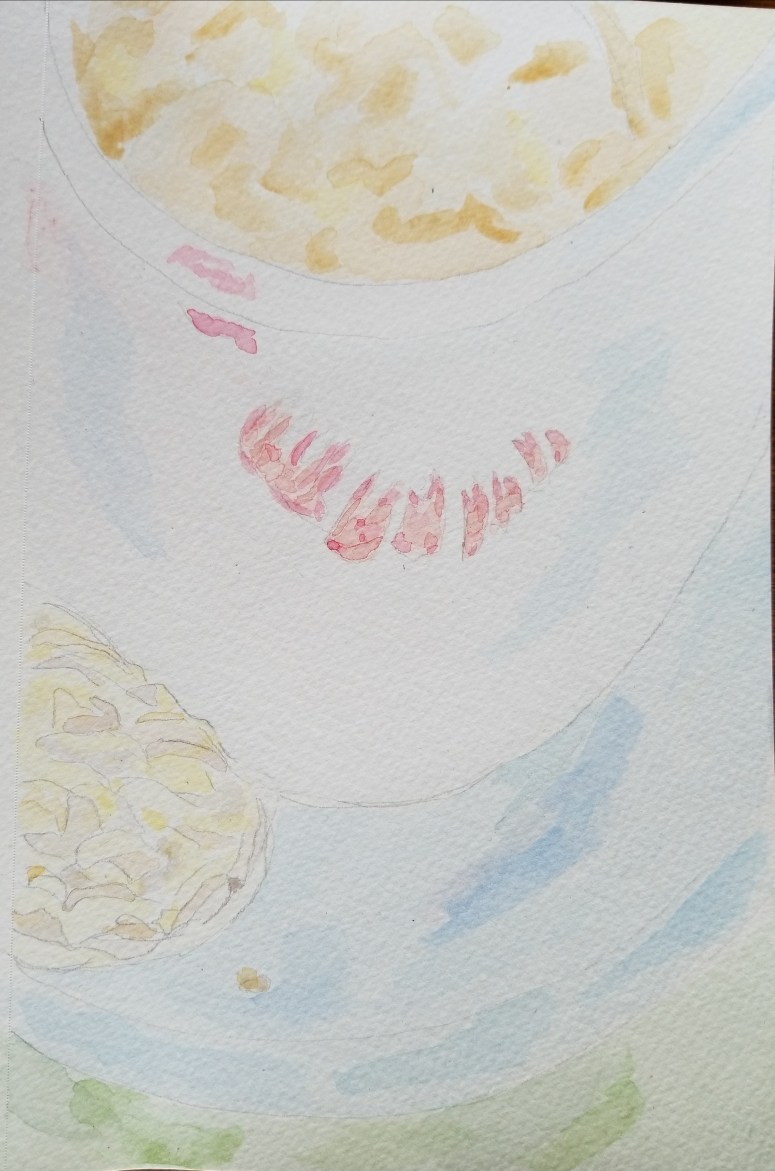
Gougiere & Consomme

Watercolor & paper 5.5 x 8.5

Progenitors of cubism Picasso & Braque used what was around them for subject matter. Anyone who spends time not as a tourist but living in  Paris (as I do) knows that in a studio, wine & alcohol bottles are ever present along with other signs of entertaining such as packs of cards, cigarettes and the odd article of clothing left behind. These things plus the mandolin which Braque played with proficiency were all grist for the mill of early cubist compositions.

They used what was before them as it was theirs, their lives.

Every artist should strive for a constant evolution. A part of this is creating a personal lexicon. Symbols & totems of one’s daily life. There should be no thought in regards to what makes for a veneer of hipness/coolness nor drama. It has to be things of you as you are, organically occurring.

An element of what made both Picasso and Braque abandon the genre they created was that it became too formalized. Towards the end of their involvement, for a piece to be cubist it had to contain specific objects within the pictorial landscape.  What had come about to create an artistic freedom started to become as rigid as any other preexisting genre.

Although it is not a steadfast method for myself with every piece, i draw & paint what is before me. I do not give any forethought to if it fits into any preconceived notion of how i want it to be perceived. It is something i do, i like, i see. My own visual language of my life.

This is an honesty and reality which is the best way to convey emotion regardless of subject matter.

I like good conversation and aside from drawing, that is my other constant no matter where I am in the world.

This is from the last short trip I took. I like to take a small detail of a larger scene of what I am doing and make that the focal point. The latch of a window, lipstick on a cup.This piece captures that although not in an obvious way.

A glass as we converse in lieu of portraying the sketchpad I was using, the language of me.

gougiereandconsomme


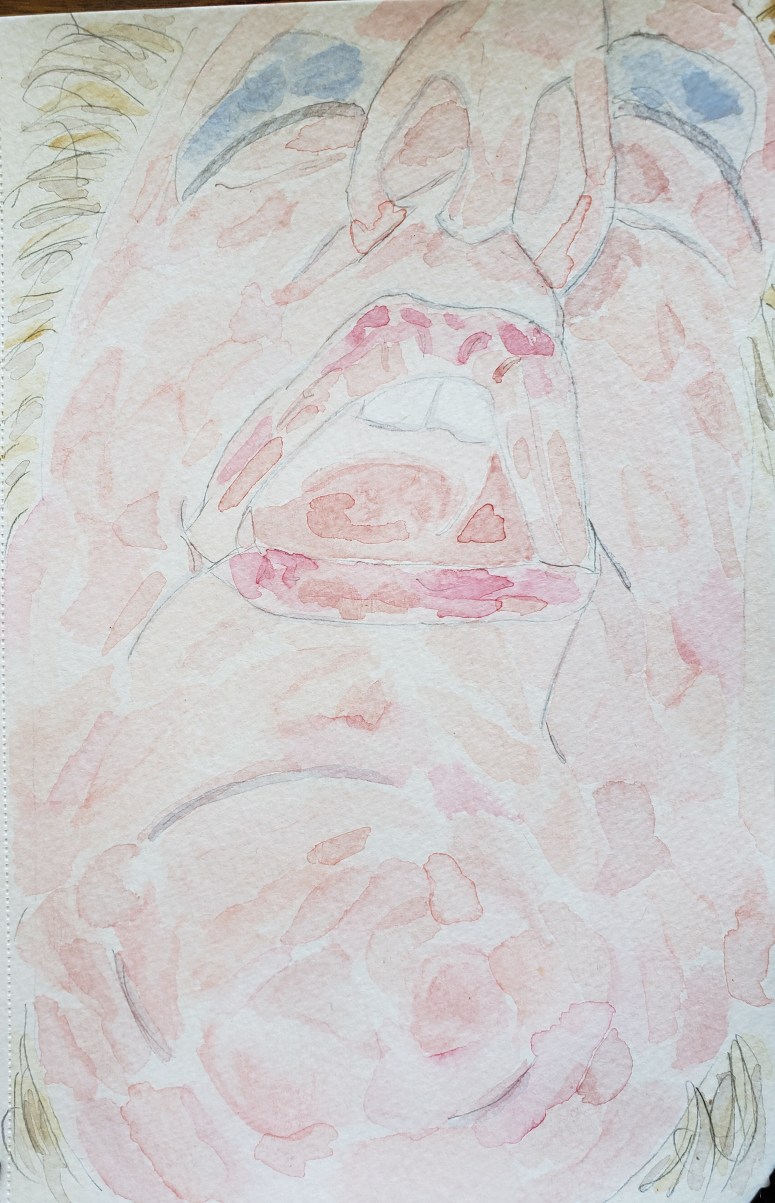
Against the Glass 2

Watercolor & cotton paper 7×10

One of the greatest pleasures in painting for me is to be able to show volume & mass on what starts off as a flat white square.

Portraying flesh allows for the suggestion of warmth in subtle, organic ways. And the sense of motion, even if only in that of the subject having become still to be portrayed also holds value to me.

Close up pieces appeal to me for their ability to teeter on the edge of possible abstraction while still conveying emotion.


againstglass2

Poem

Watercolor & 7×10 Cotton Paper

Compelling works of art regardless of medium, allow one to return to them again and again without diminished enjoyment. Another point of pleasure is in the ability to find new things in a previously enjoyed work.

In painting, especially the representation of flesh, this opportunity is ever present.
I get pleasure from portraying not just volume and mass, but also creating a sense of depth on what started out as a blank white square.

While I could accomplish similar feats in representing say a piece of fruit, skin allows to for the suggestion of heat as in a blush, motion as in composition of limbs and what is hinted at in the purple-blue of veins.
For the viewer to come away with any sense of this after looking at my work is the greatest achievement for me.


Poem


Witold Lutosławski

Watercolor & Paper 5.5×8.520180304_144412

Music is my main source of inspiration. I do not limit myself in regards to what I listen to. There are some definite favorites but I am constantly exploring, pulling new things towards myself.

There is the desire to always be evolving as an artist, I want my voice to be recognizable but I do not want mere mannerisms. Aside from challenging myself in what & how I work, expanding what I listen to is another part of my method. I do not embrace something only to down the line drop it for something newer to me but rather use favorites as navigational points into where else to explore.

Stravinsky has led me to Witold Lutoslawski (1913-1994). I instantly enjoyed everything i heard by him. Like some of my other favorite composers, it is not something I can put on at just any time but when I do put it on it deeply resonates with me.

When I do a portrait of a musician or composer, it is interesting to consider if, someone viewing the piece not familiar w/the subject would see it in a different way than someone who knows their work.