Fa-Flex

The propaganda aspects of a lot of renaissance art has been lost to the more casual peruser of paintings and sculpture. The shorthand of what they were doing has now become that Michelangelo, da Vinci et al were presenting the physical ideal. The ideal being equated to something to strive for regardless of its impossibility.

Part of the magic of painting which started with the immediate precursors to   impressionism (Courbet, Fantin Latour, Millet) was that they were begging to slowly move away from the subjects when not a still life or landscape being restricted to  those of myth, biblical or historic. The heroic, idealized.

When the Nazi occupation of France became inevitable there was a scramble to get the high profile residents, thinkers, politicos and artists to safety. Matisse was on this list. At the last minute he backed out of fleeing, saying:

“If everyone who has any value leaves France, what remains of France?”

After the fact asked to expand upon what he meant in greater detail he cited culture not personality as what he had been getting at. If the abstracts which gives us pleasure, define us and add to us are gone then what is the point?

Unfortunately in current times art and culture by default often is associated with an elitism. Art has a duty, not in the sense of promoting a message or agenda though. Now is the time for any who can, to create something of beauty. And if you can’t, it is of equal importance to appreciate and enjoy it.  The purpose art and beauty can serve now has changed since the renaissance. None of it should be tied in with any sort of “ideal”. It represents something not necessarily perfect, an impossibility to be striven for but rather something outside of ourselves, the “I” becoming part of a greater whole.

This should bolster the thought that no matter how bad things get, we all have to live with ourselves when it’s over and back to normal. Paraphrasing Matisse’s train of thought, to lose what we value about ourselves as a society just to stay around, well what would be the point?

W.Wolfson 2020

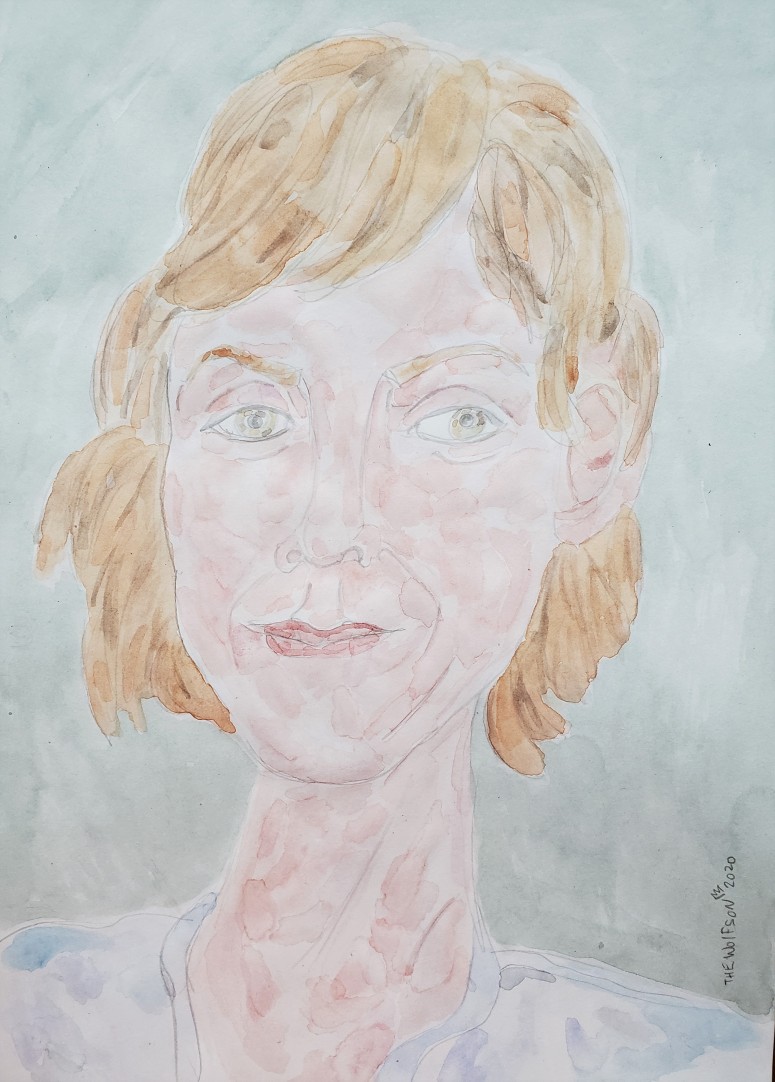
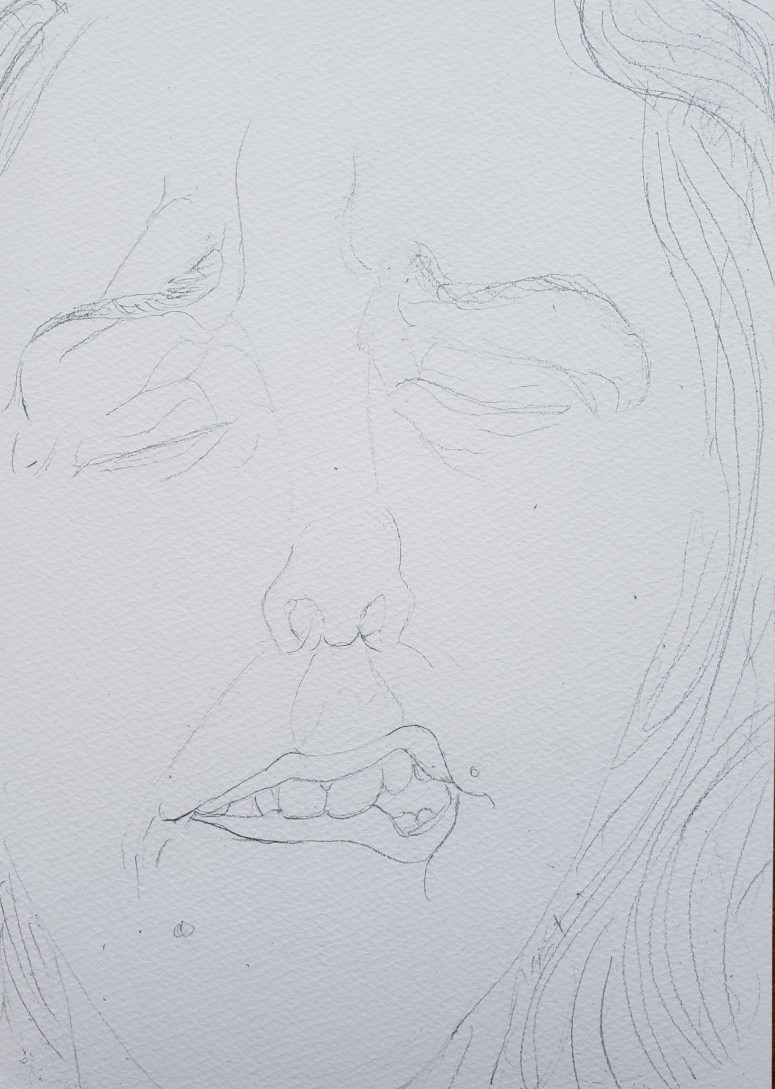
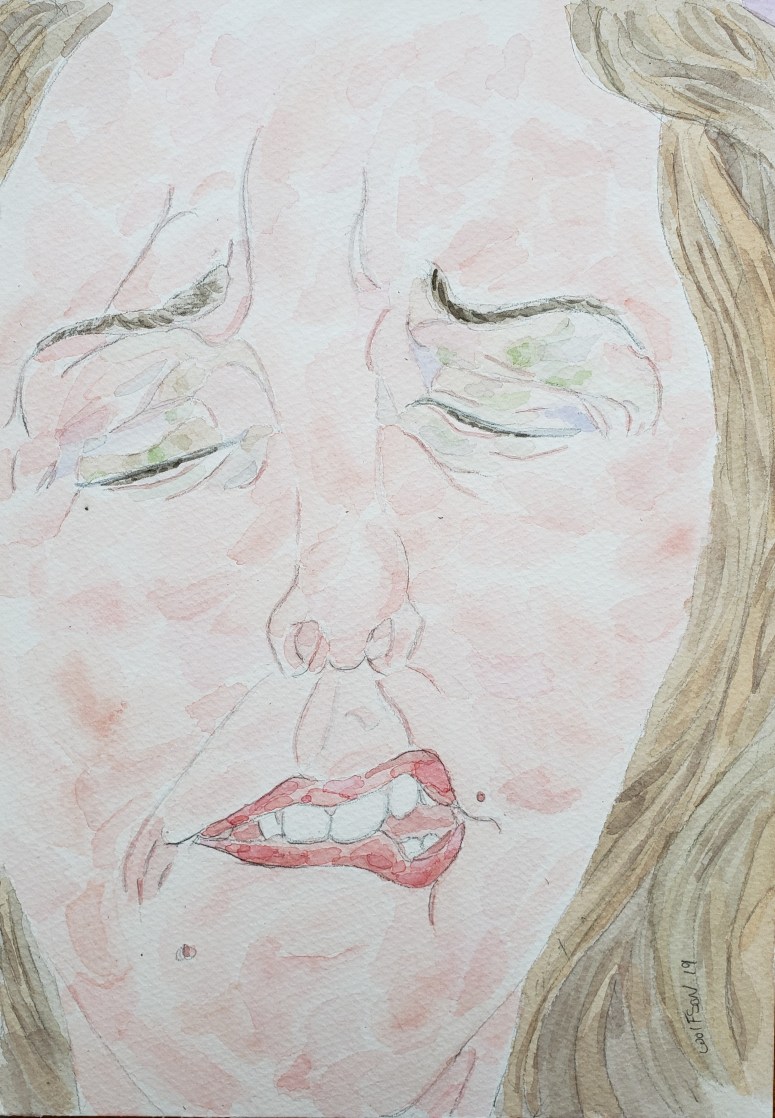
“Fa-Flex” Watercolor & French Cotton Paper 7×10


Fa-Flex


Si G

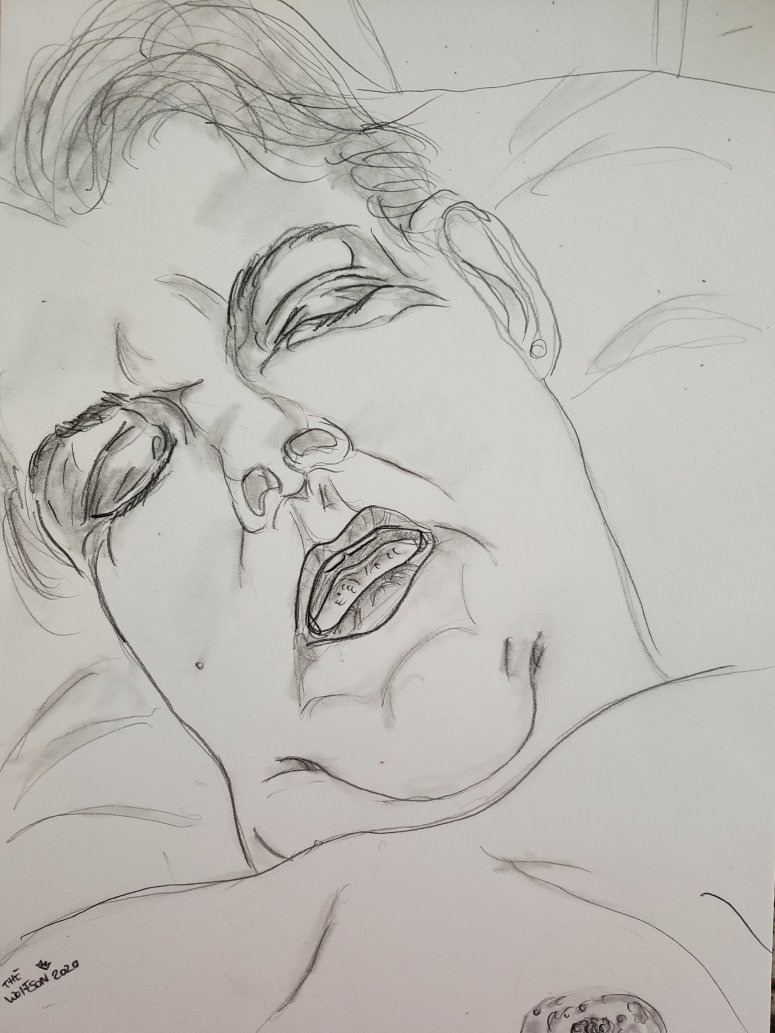
This is 9×12 Multi-Media Paper & Watercolor. It is spiral bound but not perforated which means every piece must carefully be cut out of the book with an exacto knife.

I sought to capture the merging of public & private emotions that played upon the face in this piece.

SiG

Cinema

Regardless of subject matter, I always like my work to give the sensation of the viewer as voyeur to something.

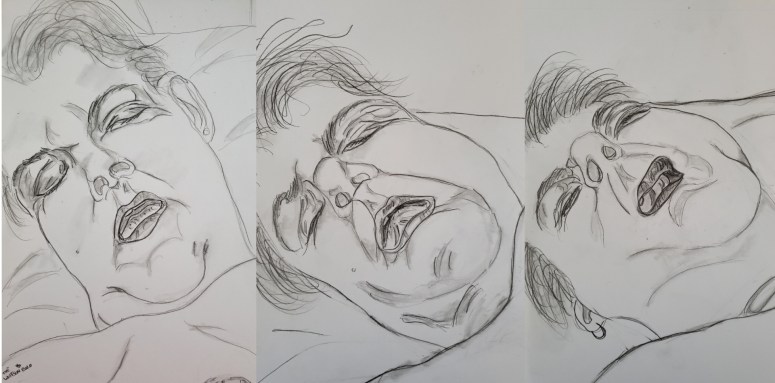
If you take footage of someone, whether they are crying, laughing even just talking, looking at the action one frame at a time the face distorts. There is a difference, sometimes drastic, from how it looked even a few frames beforehand. A neck will swell out, the nose seems of a different shape. The difference can be markedly different, each frame going towards forming a crowd of people who look similar but not exact as can occur within a family.

I decided to do a short series of 3 panels each 9×12 sequentially of a scene. I achieved the effect of what I was viewing.


49357279722_212315a149_o20200109_194707

Macaroni & Pancetta

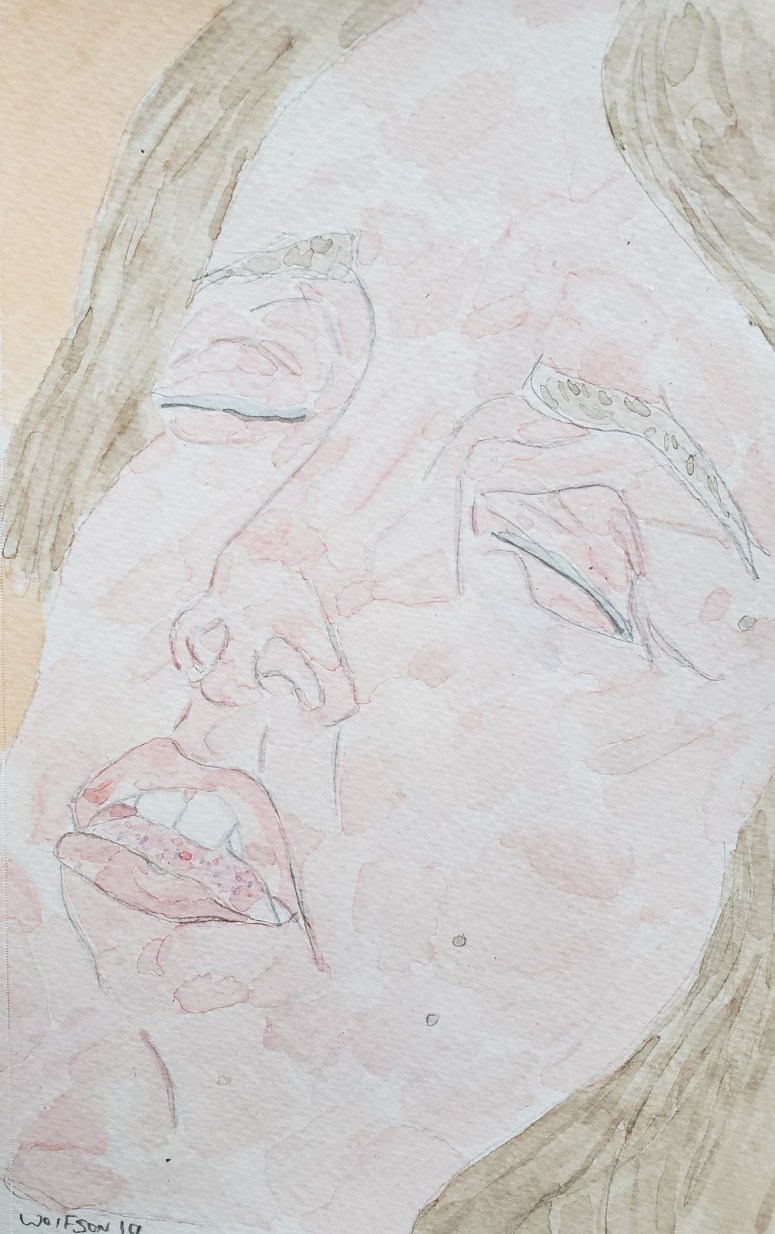
Everyone’s face is akin to a great symphony. In constant flux, this ever changing canvas upon which we paint our feelings, secrets and ambitions never ceases to fascinate me, nor compel me to capture it. W.Wolfson


Watercolor & Paper 5.5×8.5

20191224_082435


She is Tall

I like my pieces to exude the feeling that one is a voyeur into a scene. I try to not rigidly state what the viewer is seeing. Pleasure, pain, either or so long as emotion is present.


7×10 Watercolor & French Cotton Paper


20191029_13264320191029_13270220191030_111558shestall

Caro Diario

On the road. This paper was just laying around. Although it was generally being put to use as scrap paper, it is landscape style. It was nothing fancy nor great but I decided to improvise part of my trip diary on it. It is not whether something is frame worthy or selleble but the process itself which brings me joy and is the personal payoff for me. I was pleased with the results.

20190907_135740(1)


Left Bank

What makes for a good trip or proper travel is not checking off a list of places to see with their associated objects;

The Louvre, Mona Lisa….

It is absorbing the feel of a place, ambience of scents, sounds..In taking time to do this, one notices how others live their lives & what is important to them. It also allows for a deeper memory retention of the entire experience which then adds to the “you”. It is what is actually meant by “Travel broadens the mind”.

For artists there is even more of a potential benefit.

Every artists works & travels differently. I am always “working” regardless of where I am in the world. The only variation is what equipment I am utilizing. Short trips will find me leaving the paints at home, filling my coat pocket with my trusty pocket pads as I like to travel as light as possible and most likely would not have time anyways.

Any give place should effect an artist. Not in the most obvious way such as “I am in London, I painted Big Ben”.

It is ambient light, the lines of architecture, they become further accoutrements to the palette. It does not mean that one enters artistic phases ala Picasso and Cubism et al. Rather, work done in one place  does not look exactly as it appears back home. The artists voice is ever present but there are different components to the fore, mixed in with some of the more familiar.

If you have never been or only as part of a tour group, then every place in France is lumped in together. Despite some commonalities, each area is distinctive with their own cuisine and habits. It is the same with the ambient light.

Aix-en-Provence is all beautiful yellows punctuated by bursts of trees and the sounds of fountains. Lyon is soft pinks as if the buildings are made or at least coated with the delicate charcuterie which they are the masters of making. Paris in itself is diverse. From arrondissement to arrondissement, from the Left Bank to the Right .

People, myself included, proudly proclaim themselves of their side of the river and which number arrondissement.

I like even some of the seemingly “ugly” streets with their time worn dirty gray and fatigued creams. These areas tend to be where some of my artistic heroes lived, cheap rent and every third door a no nonsense bar having been the draw.

I like working with colored pencils on gray or brown paper. I limit my palette intentionally as a challenge to myself. Getting the effects that I want in this way makes it “easier” when using paints. Although I use mainly pinks, it is realistic in that in the real world there are seemingly limitless colors but go out on street  look at buildings and the street. On encounters a fairly limited palette.

These pinks, urban children of Fauvists, remind me of some parts of Paris. Not that this color is found there but it is same effect, translated in my minds eye. This little corner I continue to pass almost daily. It has been there forever and i do not think it ever had any straight lines about it.

I initially encountered it when staying at my first great apartment. It was en route to my groceries and favorite bars. Four floors, impossibly winding stairs that made you drag your shoulder against the wall as you ascended since the light was always broken. The biggest part of the place was the bathroom, with a large old tub, frosted glass windows which opened up onto a shadowy verdant courtyard with its cracked flagstones. I kept the primitive hi fi in the bathroom doorway since it was connected to the bedroom. Only music with a minimal of voices sounded good as it was a mono player. Mostly Zoot Sims duets and Lester Young trios.The neighbors would lean against their window boxes of geraniums smoking and slowly nodding their heads to the music. Dark silhouettes with one wavering orange eye-dot that would flare with inhalation.

Hard work and I was fortunate to be able to trade up apartments. I remained in my neighborhood just moving a few streets down. The building has become one of the visual shorthand for the deep affection that I hold for the every day in Paris and those first exciting years.

W.Wolfson ’19

Left Bank 9×12 colored paper and pencil


20190712_073738


Two

I have a definite methodology to how I work. But on the road there are variations. This is an aspect of how I feel a location should subtly add its flavor to work being done (there). In the states, I do my hour or two of woodshedding at night, the end of my day.

In Paris the lighting is better to do it in the morning with my coffee.

Even in my stateside studio, different times of year present better hours to paint by, as I use natural light to do so. It takes anywhere from three days to a week to really nail down what hours to pick up the brush. I am lucky though, that there are some aspects of a piece that I can do in less than ideal lighting.

I do not go to museums every time I am in France, as I know that I will always be back. Sometimes all I need is the poetry of the streets to inspire.

There is the constant though, of chatting with my peers.

While here, a huge sale by a post-pop artist got us all talking. The question of “Is it art?”

Eventually we all got bored with gnashing our teeth and started discussing nudity in art and the conected social mores in North America.

There is a cyclical debate of what seperates art from eroticism (“dirty” or “porn” labels)

Some say it is merely a matter of intent. This is too simplistic and facilitates filling the room with devil’s advocates and semantics.

Of course,  intent is always important as proven by Duchamp, but a more reliable yardstick which also keeps in mind a modicum of rationality are the components and concept of the work.

A work can seduce or excite but is it doing so because a main componant is titillation? The same question can be asked of shock value. If a work happens to induce heat, then regardless of why, it can’t be “dirty”. Someone setting out first and foremost to excite makes it so that a different label may be appropriate to apply.

Courbet’s L’Origine du Monde comes to mind. It is graphic to some but beautiful, there is no question that it is art.

The first question being asked should never be “Is there nudity?” nor even necessarily “is it art?” but rather, “is it good ?”

Having to ask if it is art is sort of like  guestioning yourself if there has been too many drinks to safely drive home, it becomes almost besides the point.

I used my canson watercolor paper 140 lb. A thing which appeals to me about it is that it’s not temperamental, being effected by wet weather as the French cotton ones that I used to solely use was.

For photos of my work I am just using my phone and as the paper has little tooth, the photos (I never work any digital magic on pics) gives accurate gist of a piece.

Song & Bellissima 5.5 x 8.5 watercolor and paper


20190519_08160620190524_183336

Raspberry tart

Where a painter who eventually becomes famous worked/lived does not necessarily reflect their posthumous reputation.  This is because more often than not the factors in no particular order are location, price and availability.

Not apparent from the work with which he became known, Paris was very important at the start of painter Ellsworth Kelly’s career. Several years ago, address in hand, I hoofed it over to this first studio (which remains just an apartment, having probably passed through dozens of hands since he lived there).

It looked just like all the other apartments arround it, neither more spacious nor with better light.

This year having read Jed perl’s excellent book on Alexander Calder, I decided to take a look at where on of his studios was. Once again, it was the same thing with the added touch which I think he would have appreciated, of a Chinese restaurant below his place.

Most people, when they think of an artist’s studio are imagining a large space, perhaps with a skylight or two. Or at the very least something which will look suitably dramatic and cinemesque upon seeing it after the fact.

For every Cezanne studio museum, there is Kelly’s or calder’s.  This is because no artist is thinking in terms how it will look once they are famous and gone. Calder liked most of his Paris studios because they were an easy walk to the cafes he frequented and his friends, yet slightly set back as to avoid the noise keeping him up.

Kelly’s motivation  had been the even more pragmatic financial one.

Another aspect of the painter life which many give no conscious thought to is the personal visual lexicon. This ever growing vocabulary is made up of the intentional such as portraits but also the instinctual. This is the every day as encountered by the painter, not made dramatic but rather it’s beauty drawn out. Cezzanne’s apples, soutine’s elevator operator et al.

The painter is not bragging of the incredible life lived a la some instagrammer’s vacation or food photo. They are recording the every day encounter(s) whether it’s the view from a studio window or some utilized necessity such as hat or groceries waiting to be put away.

I had no ambitions towards this as I had been unaware of the phenomenon until I started practicing it. The concept of “draw/paint from the guts” doesn’t mean to viscerally go at it until some sort catharsis is achieved. This misconstrued point is more about conveying the true, the reality without over thinking it nor worrying about drama.

Now one of my greatest pleasure in life is capturing on paper some little thing as it is from my daily existence. As ever, serving the process has become the pay off to me.

This is my second Paris painting this year. A dessert I had meant to try for a while, which was delicious.

I used 5.5x 8.5 spiral bound canson watercolor  paper 140 lb. When i first started painting i used exspensive blocks of french cotton paper. This was initially my practice paper. Although the paper’s “voice” is inherently different, I have now long used it for fully realized pieces, espcially when traveling.

Raspberry tart

20190515_134535