I am in the middle of working on another Cinefield®. This means that painting temporarily takes a backseat. Like many of my musical heroes, I will still woodshed every night. My version of playing scales, sketching hands, eyes et al.
Drawing is not a second class citizen for me. It is very much a part of my “I”. While it does help with my compositional eye in photography and sense of rhythm with my painting and Cinefields®, I view drawing as a separate and equally important medium in itself.
Both Matisse and Renoir had said something along the lines of an artist should take time every day specifically to sketch things very quickly. In working fast, eventually one is able to capture the essence of a thing with a minimal of lines. Once you can do that, then when you slow down for a painting or longer worked on drawing, then it is easier to bring out the essence of the thing.
Here are some recent quick pieces:
Lyra Piece 5×7
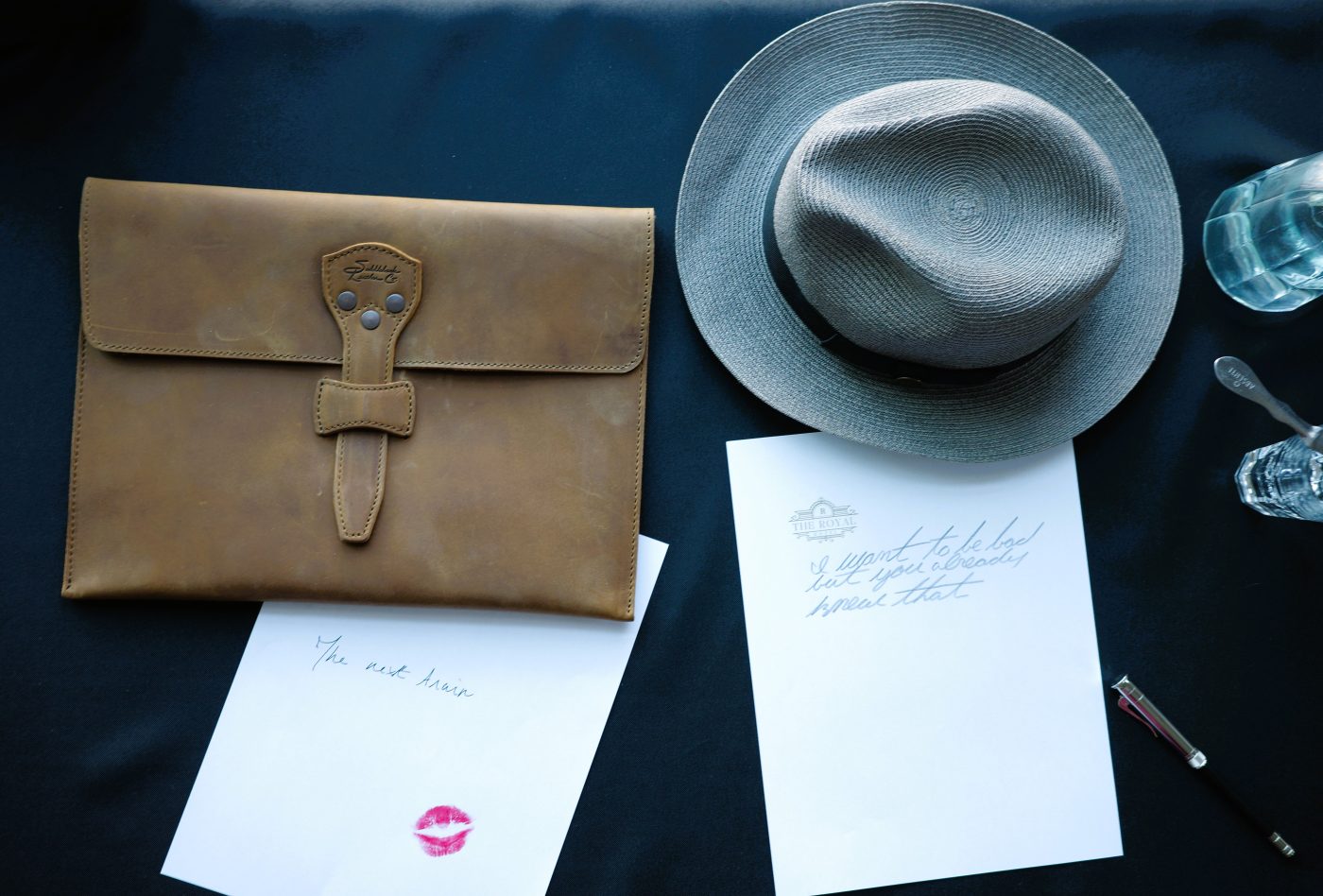
Quick sketch & text by Me
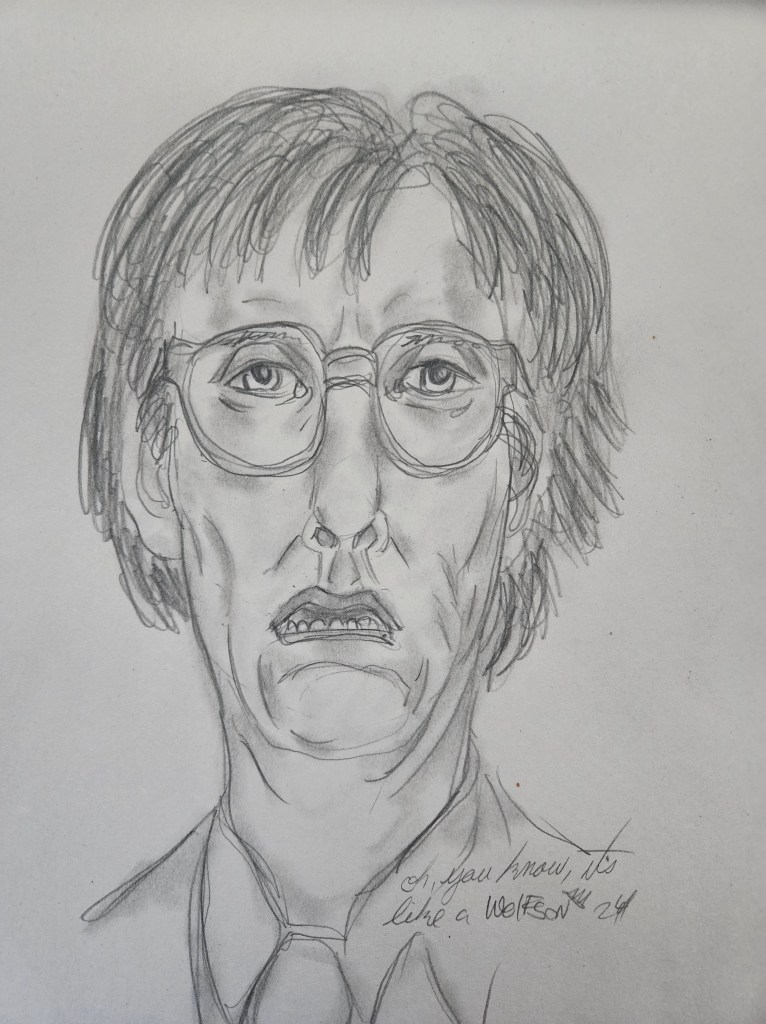
Elliot Gould. If you haven’t seen it, highly recommend the movie “The Long Goodbye”
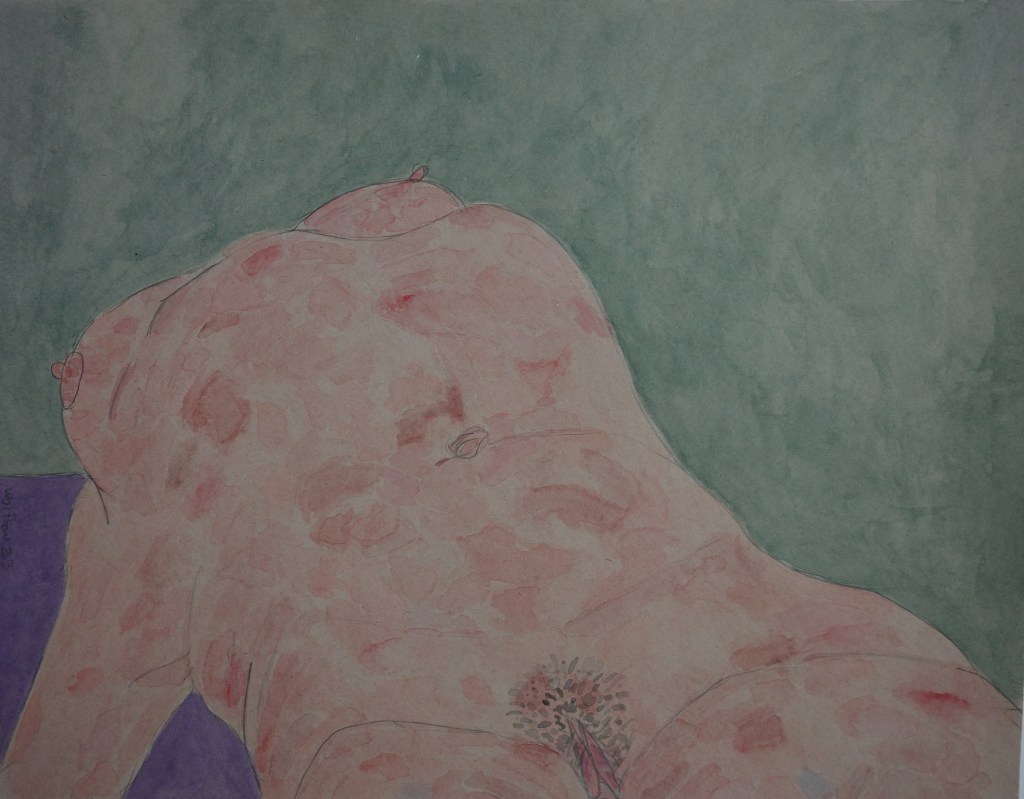
This is my first painting of ’24. I am very pleased with it. 11×17 Watercolor on tan paper.
As seems to now frequently be the case, the news is bleak. It is the duty for all artists to do their thing. Not put political messages into their works but rather offer up something outside of the here and now, which will some day be over. Facilitate inspiration and show that there are things bigger than ourselves, which are eternal. Things like art, culture, beauty and the general human condition.
The reason why artists such as Shakespeare & Homer are still so revered is because they reflect the human condition. Of course the social mores & politics have changed but things like joy, desire, grief, we can all relate. And that is one of the things art should do, relink us, especially now.
If one is not an artist, as important as the creating is the viewing. An artist with no audience becomes akin to the riddle about the tree in the forest. Take the occasional break from doom-scrolling. Try to If not every time, then every other time, when the urge arises to engage someone in what will ultimately be a futile bad vibe exchange over points of views, instead explore a new painter, author or piece of music.
In this way, with very little effort we can all improve the zeitgeist.
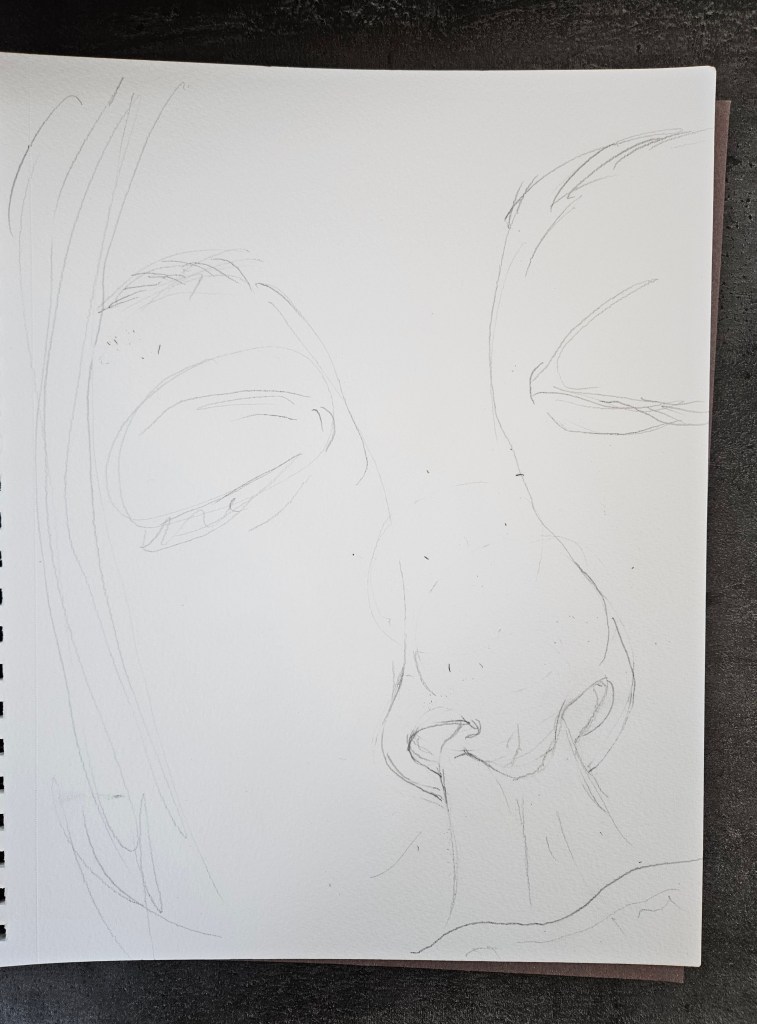
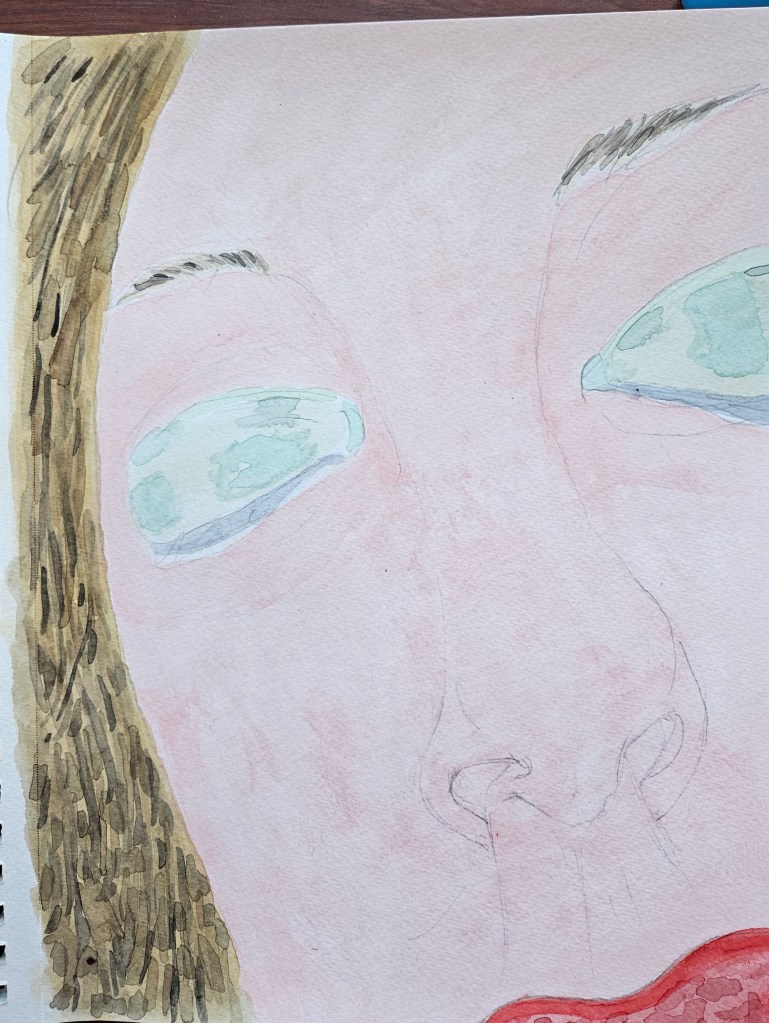
I have started another painting. This one is on French cotton paper. Between rain and general dampness in the air, the weather has not been obliging me. I have had to takes days off.
In the interim, as usual I draw while working more on my next collection of stories & essays.
Here are a selection of quick sketches & musings done over past week.
Read enough biographies on artists and regardless of medium and era a commonality becomes apparent. It is what I call The Sweet Spot. This is the time when the struggle/work for the artist to achieve their distinctive voice has been achieved. All the work which goes towards fostering the skill to do so now takes no more effort to motivate into action than a health habit. And there is now an audience which gets rid of the abstracted “someday,,,” aspect the lack of which causes the “Why am I doing this again?”.
There is an audience but not so big that the artist, even if only on a subconscious level, incorporates into the equation all the expectations of fans, critics and gallerists. There is the luxury of being able to work and experiment giving no thoughts to consequence.
More often than not, the artist recognizes this golden age only after they are well past it. If lucky, in old age they may get a second shot once established as an institution or national treasure but this is not always guarantied.
I feel fortunate, for among other things, recognizing that i am in the sweet spot. I decided to try a bunch of new things for this painting. Why not? I am very pleased with how it turned out. To me, it does not look radically different from my other paintings despite all new things I tried.
compulsively, I read biographies on artists of every medium & era. I will even delve into people who are not my usual thing which has more than once made me become a fan. There is a commonality which transcends both nation and decade, that of practicality initially dictating artistic direction/materials & methodology.
The Impressionists are mainly talked about in relation to how they used color and lighting effects. Their importance was not just their revolutionary portrayal of light as it effected perception though. Before them, some painters had started breaking away from the pervading “must” of people being heroically portrayed ala history/myth/allegory (Courbet & Millet had started towards more naturalized milieu) they were the first to fold it into their works wholesale.
People were portrayed having an eye opener in a cafe before work, dirty nails, bad skin. Objects were portrayed in natural positions, a wife’s hat left atop a shrub, detritus atop a studio table waiting to be swept with forearm into the trash.
Part of the reason for this all was practicalities sake. Models could not always be afforded and it was easier using friends and family to pose, especially as scheduling could prove to be more convenient and often all it cost was to eventually return the favor.
These things would be enfolded into the methodology of their work and then honed. After this point, it was became their lexicon.
The same thing happened with Picasso/Braque cubist still lives, it was just things they had laying around which were part of their every day lives. Money need not be spent on flowers or any other kind of specialty objects. The only downside to this was that by the time Picasso was moving on from cubism, cubist paintings by participators in the genre more often than not had “required” objects to be included which had initially made appearances in a natural manner due to pragmatism.
Practicality is often an important initial dictator of choices an artist makes, but once the path chosen is felt to be the right one, a philosophy sprouts up. Like the methodology, it is ready to be honed, its articulation, whether to the public or just in the artist’s head, fine tuned.
The Italian painter Giorgi Morandi rarely left his city of Bologna, Italy (only three times, much later in life and then only briefly). He did not portray life in his home city but was fueled by it. He mainly did still lives. Most of these were of bottle which had just been laying around. A cursory look at his work and they seem deceptively simple. There is no bursting forth virtuosic moments to be found in his work. What makes them remarkable is that they very much look like every day objects imbued with organically occurring poetry.
A generation later and half a world away, Henry Virgona worked along a similar philosophical line. He kept the same 300 square foot Union Square studio for fifty nine years (sadly, ending in 2019). He rarely traveled, preferring to stay within the confines of the city whose fabric he was very much part of. He did still lives which showed him to be the artistic son of Morandi. He was an accomplished draftsman and this urban Antaeus did amazing candid drawings of all the people that he encountered in his daily city life, their natural poses maintain the power of the pieces. Two men, one mainly using objects, the other, people encountered every day, both showing inherent natural beauty of regular life.
I had already hit upon my philosophy and modus operandi before discovering Henry’s work. We definitely have marked differences, some of which could be generational. It is inspiring though, to see that one’s idea of serving the process is not completely out of left field but rather an evolved link in a chain which goes way back.
Most of what I work in and how I work all started out from practical considerations. I mainly use people in my life in some manner as models for convenience’s sake. When no one is around, I will paint or draw whatever catches my eye which is right in front of me. I too go for the beauty which organically comes through in every day objects or scenes.
One of my greatest pleasures in life is to conjure up, even if only with a pencil nubbin and scrap paper, either something I am seeing or talking about.
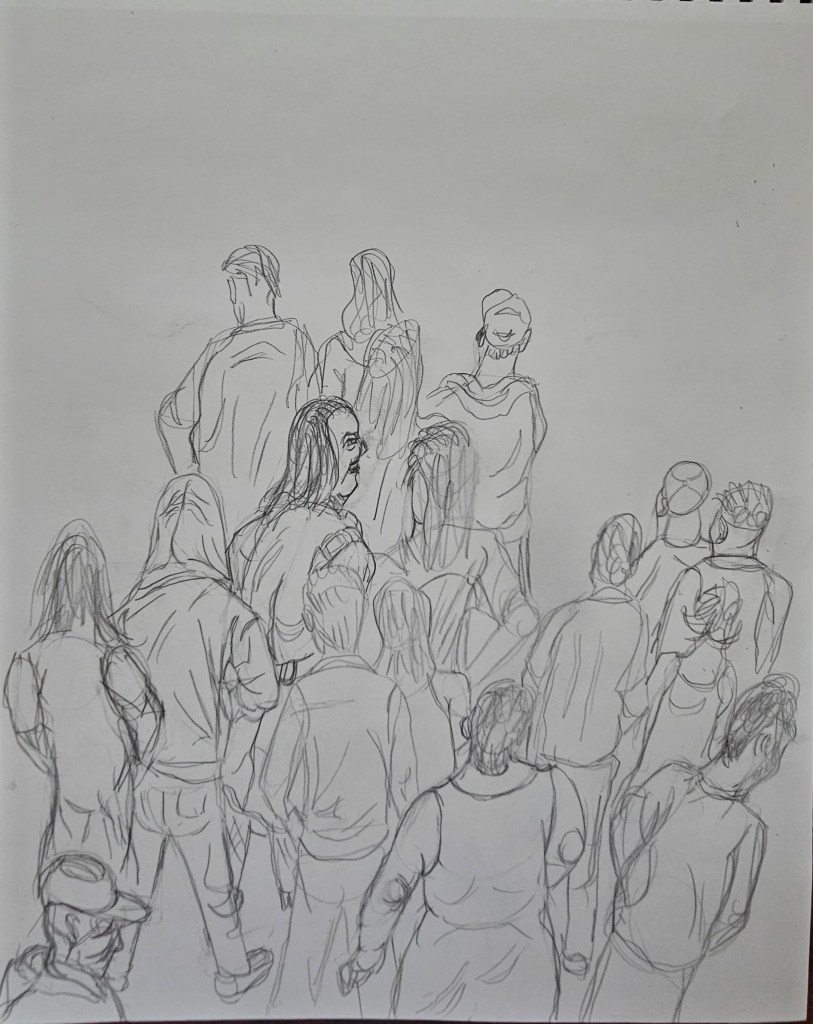
I was at a concert and observed various moments where, as much as I was enjoying the music, got caught up in people watching. Doing a sort of raw-visual-reportage after the fact, I caught the moment in a bigger sized for me piece. Aside from the size of the piece, another departure for me was the fact that I did a few studies as I wanted the crowd scene to be accurate and maintain a certain degree of looseness which already having knowledge of positioning and compositional balance would help with.
When I first started seriously painting, I used a French cotton paper. I did not realize it at the time, but it is far less forgiving than the paper which I currently use (which is non-cotton).
I made the switch when the already up there price raised even more. There was much experimentation before I found the paper which became my main one.
In cleaning my tabouret draws, I came upon an unopened block of French Cotton paper. As my skill has increased from when I originally had used it, I was interested to see what I could do with it now.
My preference with cotton paper had always been cold pressed, but even with this, there is more tooth to the paper than what I currently use. This gives a sort of chunky effect when portraying flesh, watercolor impasto.
I enjoyed using this paper and I will work my way through the block but to my surprise I now prefer my current non-cotton paper. The cotton paper does not blend as easy, so getting effects I want with cotton paper will now make it “easier” with my preferred paper.
Unintentionally, my last three paintings form a cohesive series. The news continues to be bleak. It is the responsibility of all artists to do their thing. Not necessarily art with a message but putting forth things of beauty as a reminder that there are things out there bigger than ourselves. And more importantly, not everything need be connected to a “Us versus them” issue.
As I cool down on use of some of my other social media sites I had a revelation. Just because you disagree with someone or even if they are legitimately wrong, it’s often not worth yelling back. You are not going to change hearts and minds. Even if in the right, more often than not it is just adding to the cacophony, feeding the pervading negative zeitgeist.
All art regardless of medium is a way to look towards better days, here’s hoping I see you there.
Blogs, social media, online news, news updates via text, it is way too easy to get caught up in doom scrolling. The seemingly reasonable assertion that to be hyper vigilant in regards to all the bad things allows one to have a hand on the wheel so to speak. While I do think it important to know what’s going on, a steady diet of the bleak and negative is not healthy for anyone. Even if unintentionally, you end up just adding to the negative. There needs to be some moments of calm, peace and the positive, otherwise what’s the point of it all?
I would like to think that at the very least my work offers a brief respite from the woes of every day life and its accompanying concerns. A moment of beauty to serve as a counter balance to the bleak and out of our control so often now a part of the news. Sometimes a way to implement change is by just engaging with the things outside of the struggle.
There’s been much talk lately of the negative effect on teens body images via social media. I do not disagree with this. However, the internet has always had a tenuous grasp on reality. People of every age add filters to their face/body when posting photos, all kinds of other tweaks. Then there is the side-stand duckbill face, the de rigueur for an entire generation of women when doing selfies. Eventually. this pose and look will be viewed with same amusement as footage from bygone eras where men’s hair is overly brill creamed to the point of looking plastic.
To me, the truth has always been beautiful. The truth is unavoidable too. One can apply as many filters as are available but at some point you are going to have to go out in the real world as you really are. These things, the importance of trends et al, only have the power of the importance which we give them.
The beauty of truth is why I largely prefer to use subjects (friends et al) that I know for my work. The trust placed in me means that they can relax, eschewing any overly academic or glam poses. Even after all this time, one of my greatest pleasures is to portray flesh via paint. Sometimes, I still feel like the musician marveling at the notes that they are making.
I am in the middle of working on a new CINEFIELD® and so other big works are on hold until done. There is still the nightly drawing/woodshedding. After a week or so, I find myself missing painting. I am lucky that my lyra pieces are a close approximation, it gives me the same serving the process emotional pay off.
Although the lyra pieces are also a form of woodshedding, I consider all the mediums I use of equal value, nothing is a second class citizen.. If I can get the effects i want in monochrome, especially for portraits, then when I am using my paints, it becomes “easier”.
Stateside, the news continues to be bleak. Everything has morphed into culture wars, a forced upon life or death struggles. A lot of it manages to be very serious and also absurd. It’s become too easy for one to remain amped up from a steady diet of doom scrolling, shaking their fist at the other side while veins July Fourth pop in the forehead. Even as the book banners morph more and more into (most likely) book burners, know it has to eventually pass.
In the interim, all artists have a duty to do their thing. Not to have specific political messages in their work, but to show beauty, even terrible beauty or ugly beauty. It serves as a reminder there is something bigger than oneself out there, culture. It’s a way to show that emotions besides the negative ones can be equally as strong.
If everything but the fight and thoughts of the enemy drop away, what’s the point of it all?