I have been greatly enjoying using my newish pocket pad for painting. It is interesting how ambient light effects a piece. If a room is naturally darker then the application of paint is thicker whereas a really bright space less paint is used. This is because of how the eye perceives the colors.
My studio has a natural sort of yellowish/gold tinge to it. I am fortunate in that I can see in my mind’s eye how to compensate for it.
“M After” Watercolor & pocket pad 4×4 inches
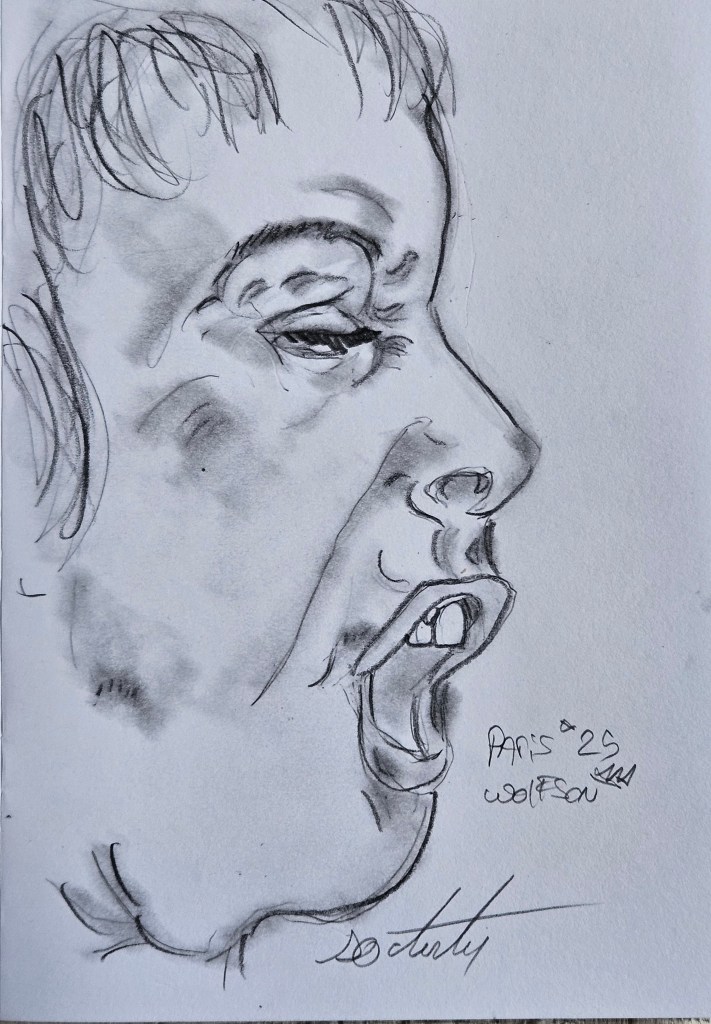
Drawing with impulse buy pencil
One of my other favorite statues in Paris
so many buildings have plaques denoting who lived there, when and what they did. There are many for Picasso who had numerous homes in the city. Sometimes an artists had many homes because they kept skipping out on the rent! With some artists you see several plaques all within the same arrondissement.
Artistic evolution is my constant mantra, with emotional resonance being my goal. I achieve if not both then at least the first by constantly challenging myself. I never want people to look at my work and after seeing a few pieces feel they have seen them all. Nor do I ever want to become the “…” guy in regards to what my voice is saying via images I use to do so.
Semi recently I started mixing it up with my Cinefield® works as I had previously been doing with my drawings & paintings.
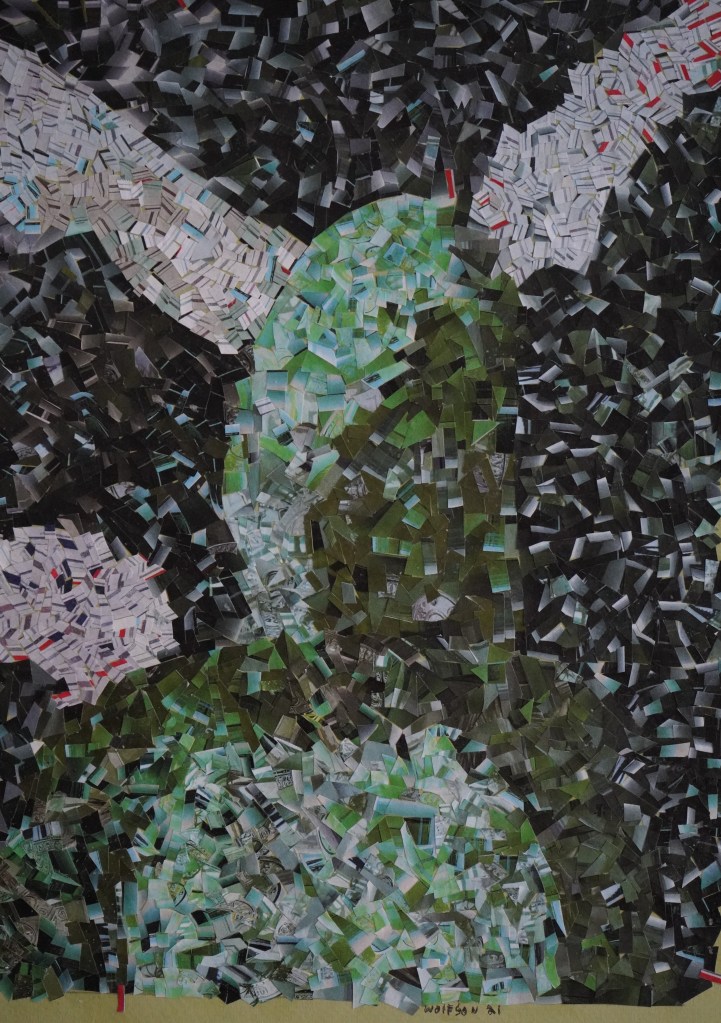
The challenge I presented to myself this time was to use only one image and one of a limited color palette.
The initial wave of Pop art was portraying common objects or scenes, things which could easily be considered lowbrow of plebeian. It was not the objects portrayed which made a work Pop art, it was an ironic emotional detachment. Someone like Wayne Thiebaud often gets lumped in with the Pop artists for his wonderful paintings of cakes and other sweets. However there is painterly intent and definite emotion involved. He is not pop
He followed in tradition which started with the impressionists of showing objects that they encountered every day. Drinks and drinkers were often used as subject matter as cafes were de facto ‘offices” for artists and dealers.
Le Buver d’Absinthe (1859) by Edouard Manet
L’Absinthe (1876/6) by Edgar Degas
Buveur d’Absinthe (1901) by Pablo Picasso
Painted Bronze (Two Ale Cans) 1964 by Jasper Johns.
It occurred to me after I started my piece that I was working, a link in a long chain of artistic tradition. I had previously done flowers, faces and cityscapes and it was the novelty of subject which initially appealed to me though, not the tradition. Before anyone accuses me of pretension, I had gotten both a bottle of good whiskey and one of Absinthe for my birthday. I tried photographing the whisky bottle first but it was just a dark brown with no color variations, I next tried the Absinthe which worked better, this being my only impetus for using it.
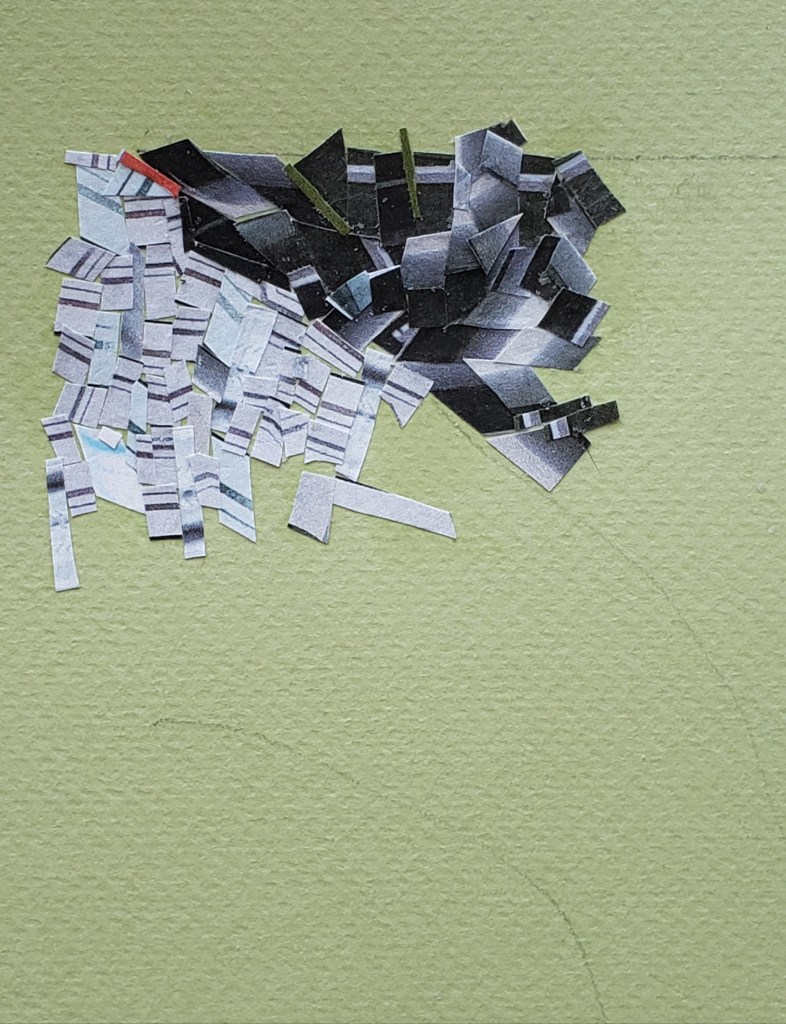
I took three photos, not moving the bottle but standing in front of it, besides it and behind it. As is true with all my Cinefield® work, I only used photos that I personally took, working no digital magic. I used my trusty scissors and adhesive applies with a brush.
The work is 7×10. Soundtrack György Sándor playing Batrok’s Mikrokosmos books III-IV, kini Rao (various), Sun Ra Lanquidity.
Addendum: People are still under the impression that Absinthe was illegal either because of the wormwood or the high alcohol content. Neither of which was true. Some politicians in France had major interests in certain vineyards and importers/bottling concessions. Absinthe was cheaper and lasted longer so workers turned from wine to that. The outlawing of Absinthe was first and foremost a financial consideration.
I am now still playing catch up with all the things I had put on hold for a year plus. I am very fortunate that none of it was extremely pressing. Dentist, roofers and a small parade of other things kept me from starting a painting or Cinefield®. I have slowly whittled the list down and started a new Cinefield®. These are labor intensive and so between the two things, it occurred to me I have not posted in awhile. While my studio is being taken over by sheets of tiny cut out images, i can not paint but I can still draw.
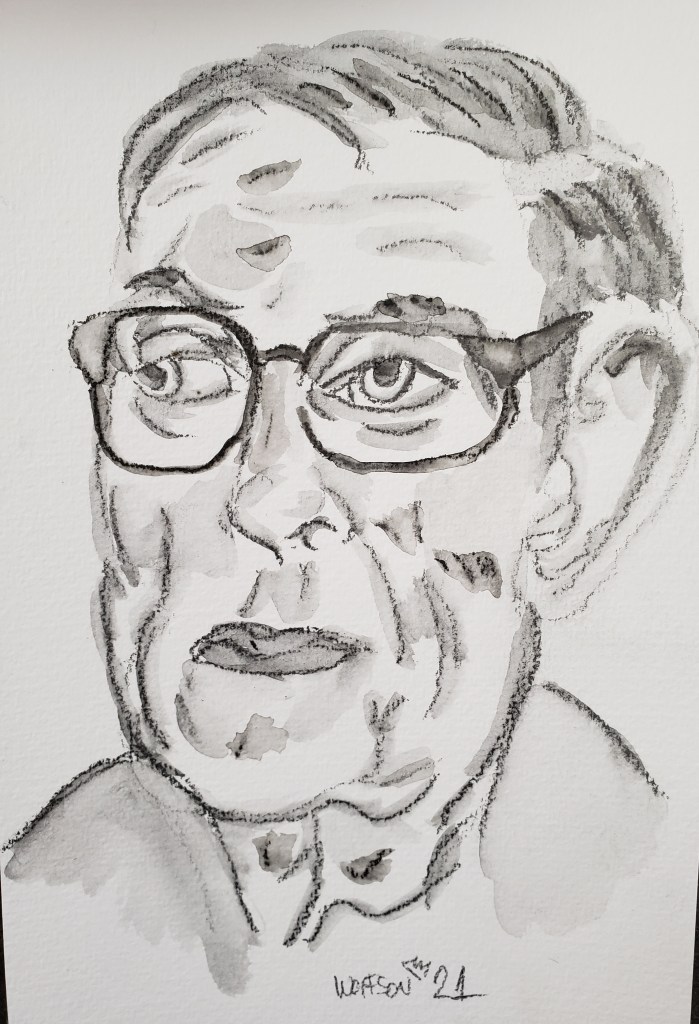
When i do short trips i do not bring my painting equipment with me, opting to just draw instead. Sometimes on longer trips even with my painting equipment at hand the weather conspires against me with rain or dark skies. By complete happenstance I discovered Lyra water soluble graphite sticks. I instantly got into this medium. It allows for painterly effects. I have a travel brush which folds into a tiny tube and this accompanying one of the graphite sticks which are size of fat crayon, now allows me to do monochromatic paintings on even short trips. The added bonus for me is that aside from how compact it is, I can use this medium at night (which I cant with regular paints) and in bad weather.
The expressionistic qualities of this medium greatly appeals to me and conveying emotion in only one color makes it that munch “easier” when utilizing a full palette.
I am already pleased with what I can do but am sure that down the line I will get even better.







 Paper Life Painting