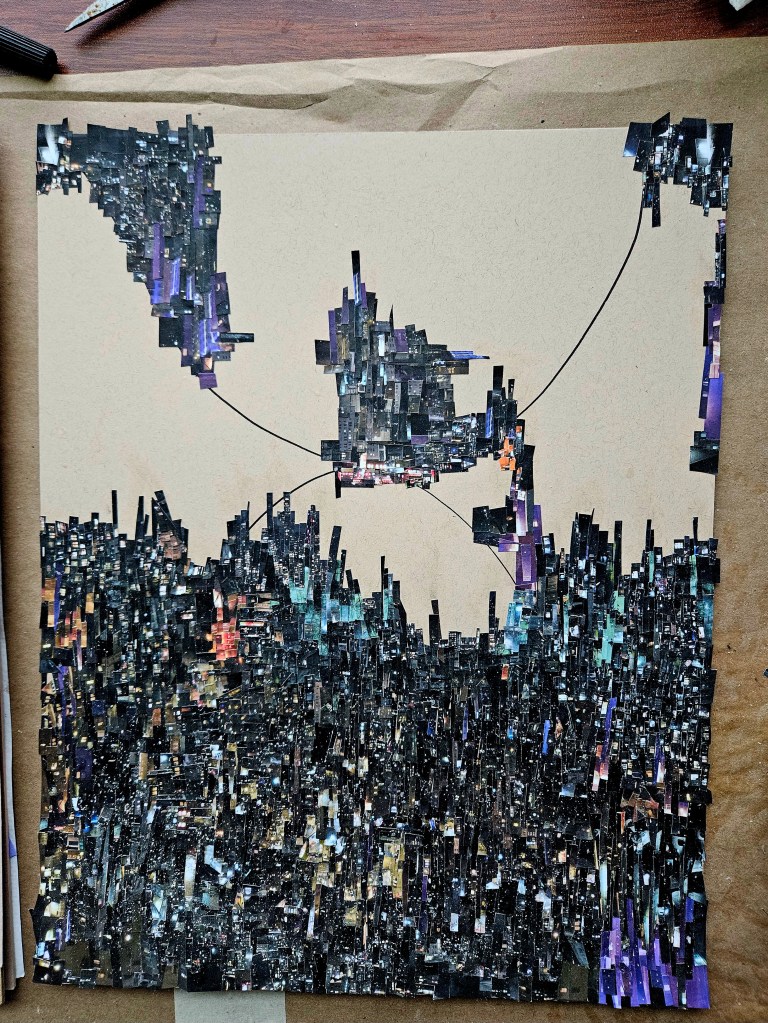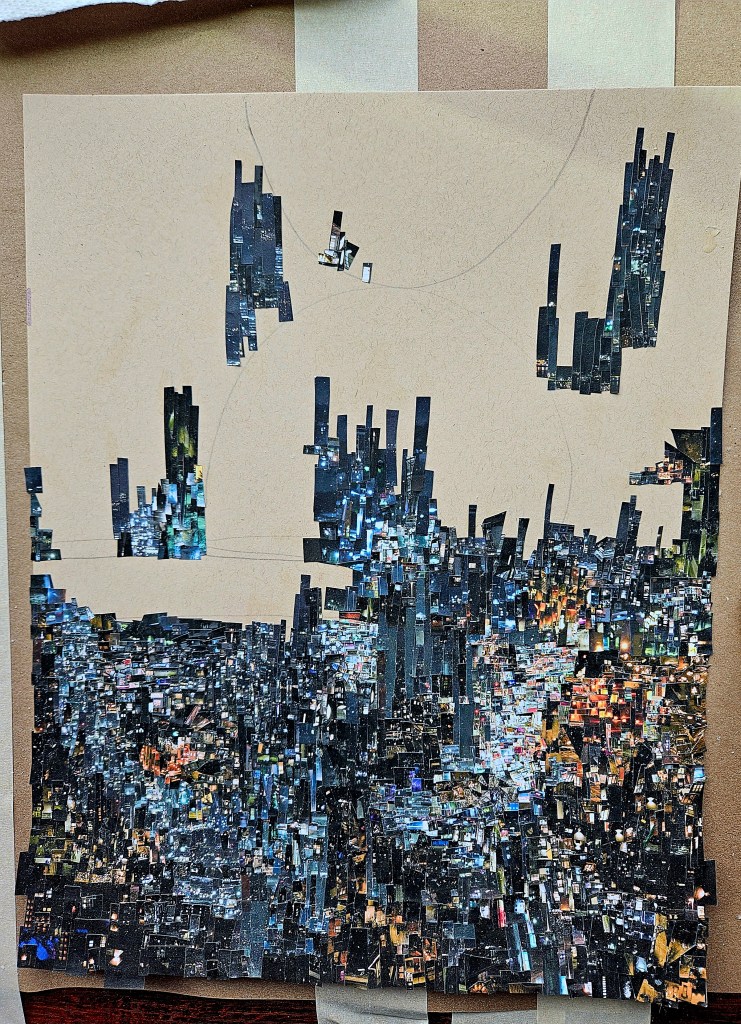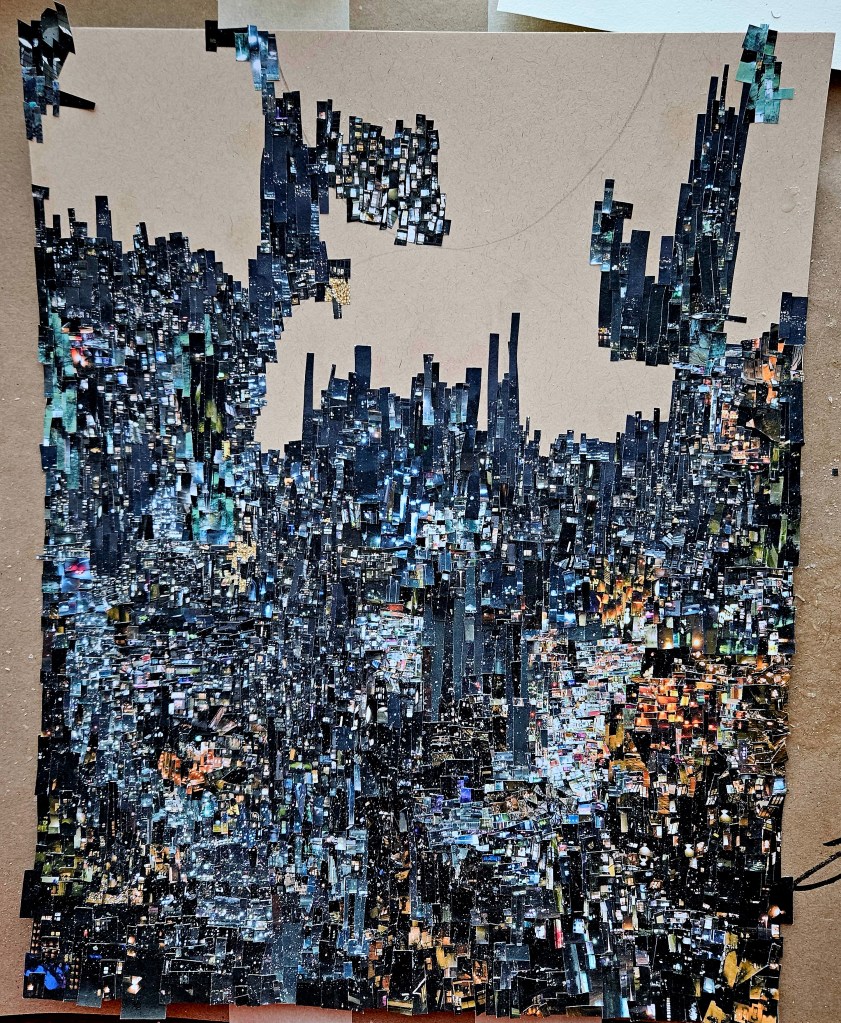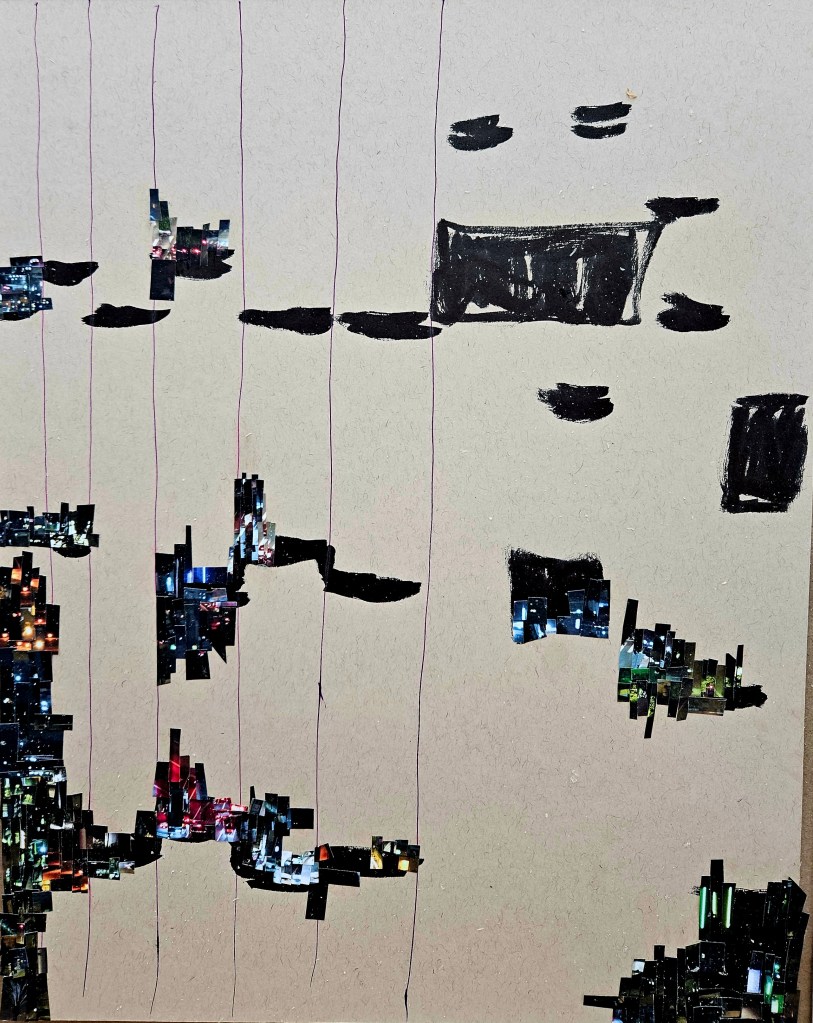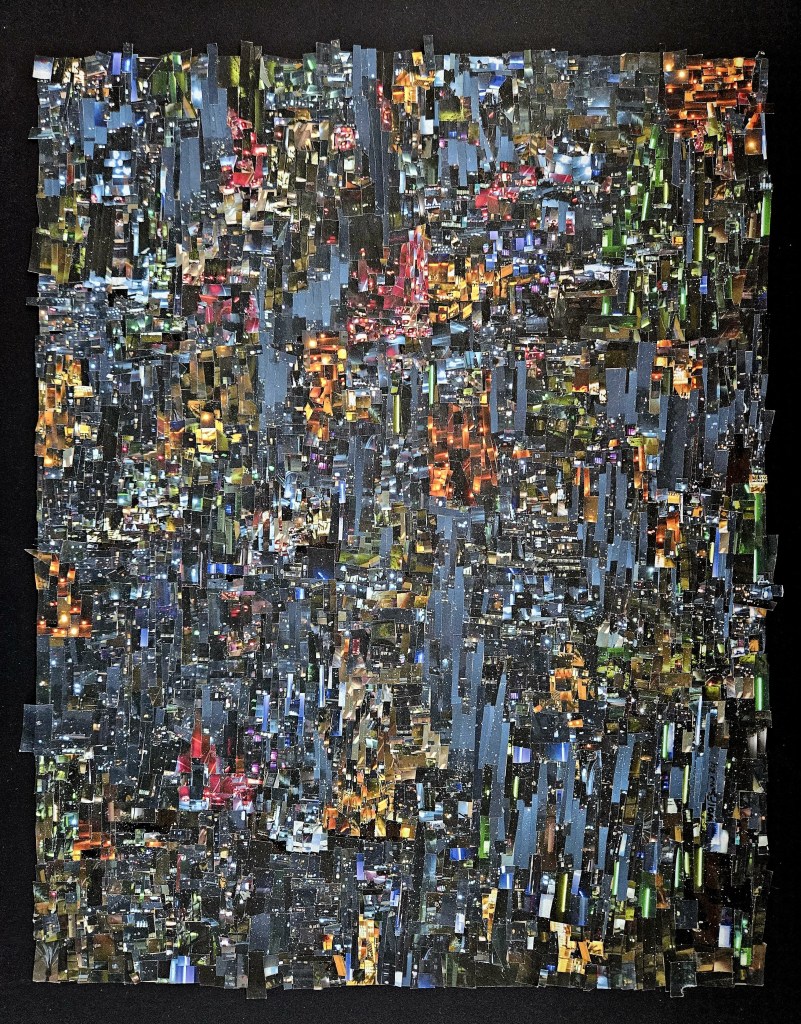
Night Tides (for Craig “Doodlebug” Irving)

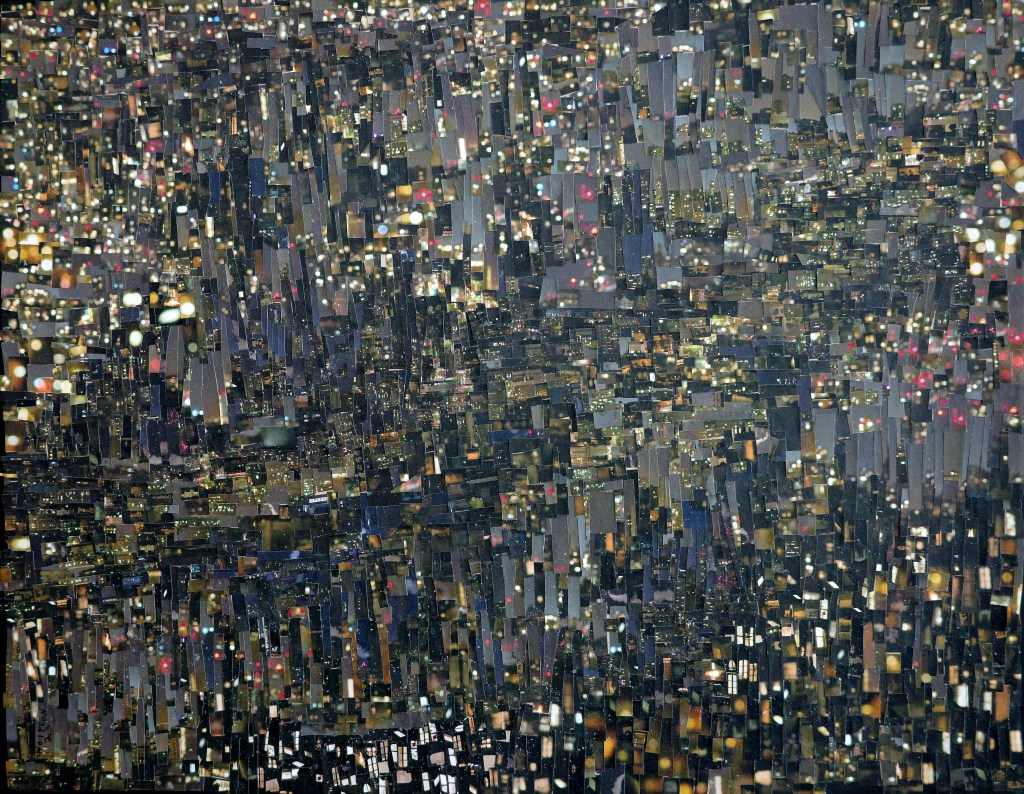
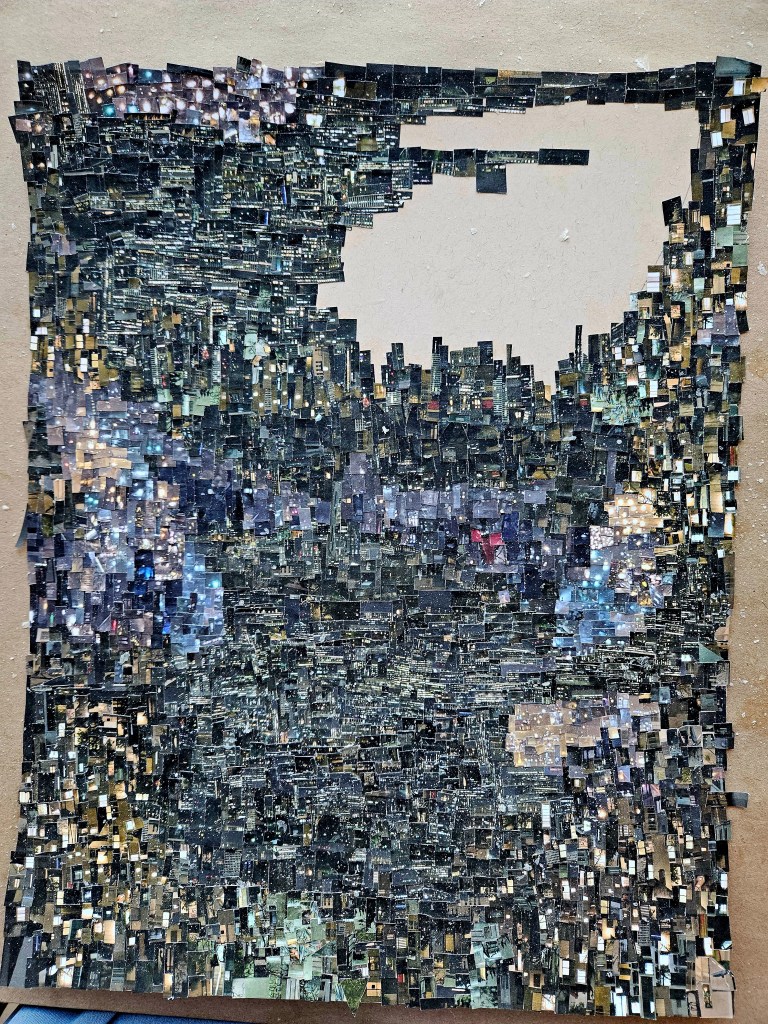
Finally finished my latest Cinefield®. For each one, my ambition is to make it better than the last in some way. In this case, it is my most rhythmically complex.

I seek to engage the viewer via creating works which offer new things to be noticed with every view. Ideally, I inspire (and maybe even awe) but if I only offer a momentary respite from the unpleasant aspects of daily life, then it’s all well worth it.

Aside from the labor intensive aspect of each Cinefield®, other information:

Each piece is comprised of one or two photos which I personally took. There is no digital magic, I use the old school method of my trusty tiny scissors and adhesive applied with brush on an 11×17 inch piece of heavy paper.

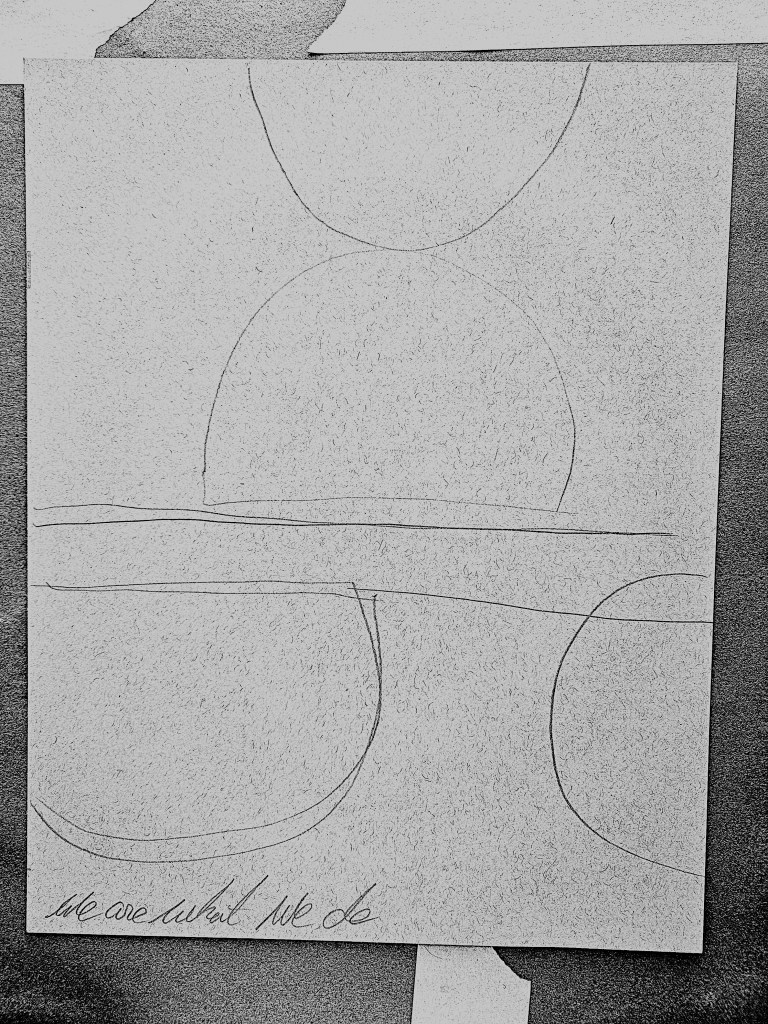
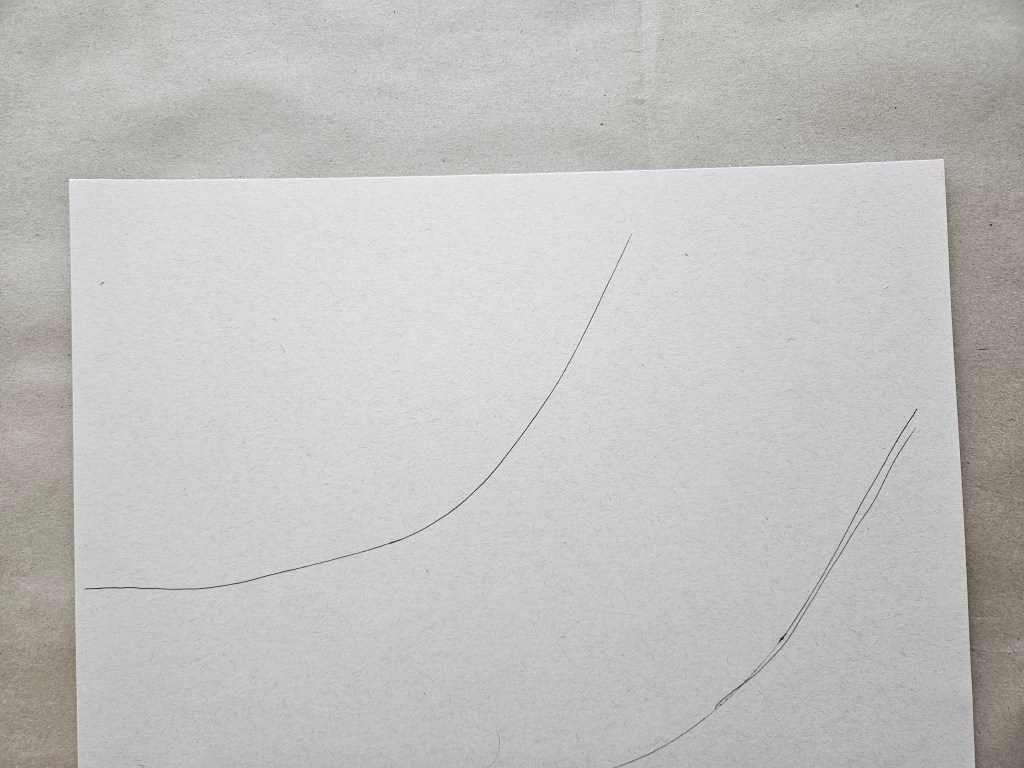
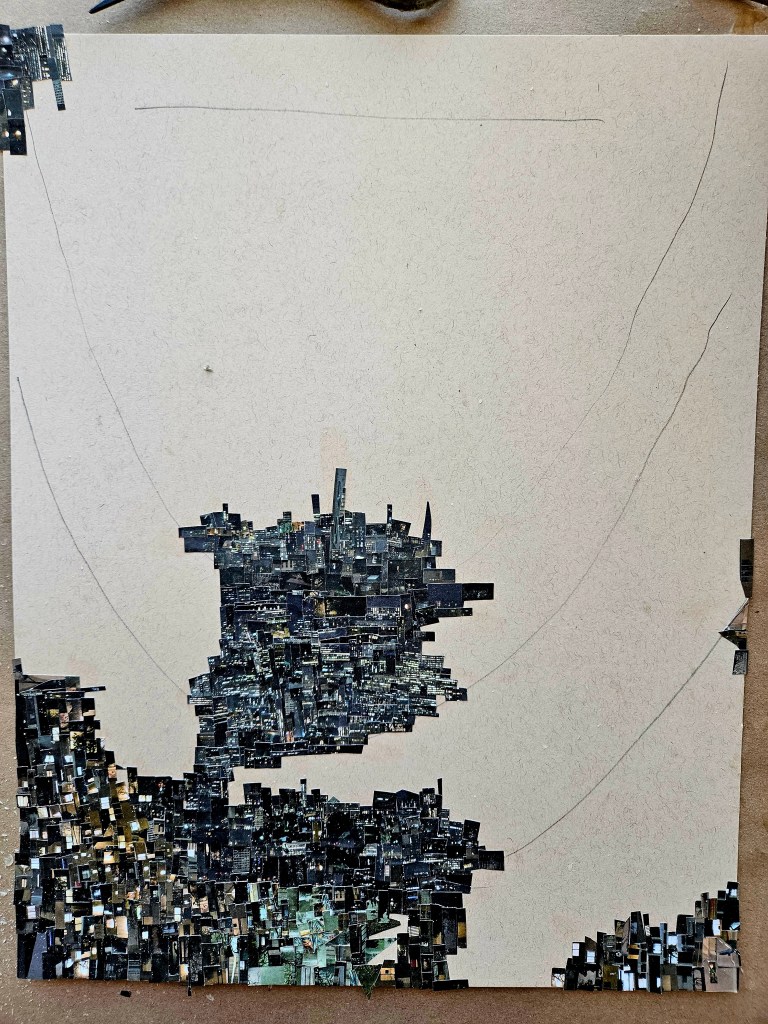
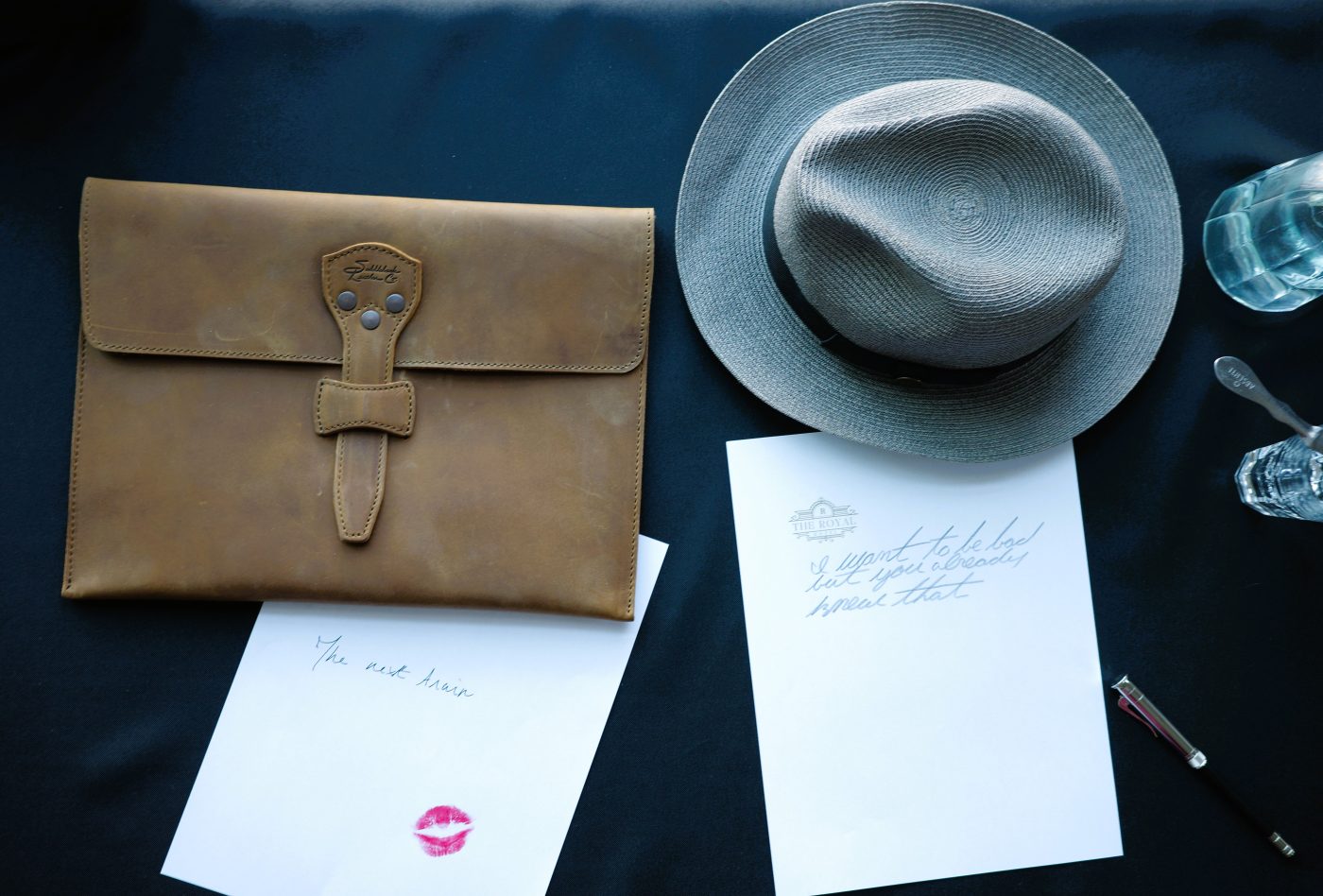
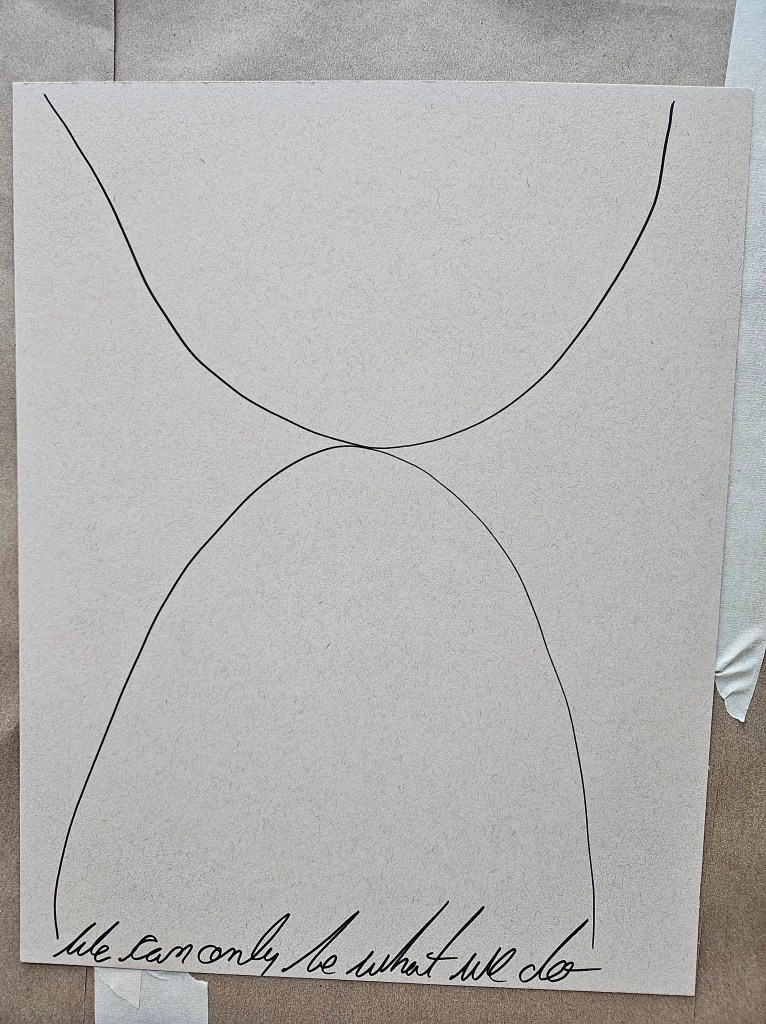
I always see the design in my head ahead of time. However, what piece is put where is in the moment improvised. I do a basic schematic on the paper the fine details reside within my inner eye. I also put a phrase which ultimately becomes hidden by the mosaic. The inspiration for this was the beautiful movie The Phantom Thread in which a master tailor did similar thing with his couture. There is such a call for meticulous detail in what I do and it’s so painstakingly executed that I have always likened it to the little old man making amazing shoes on Saville Row type of thing so these two things inspired me.

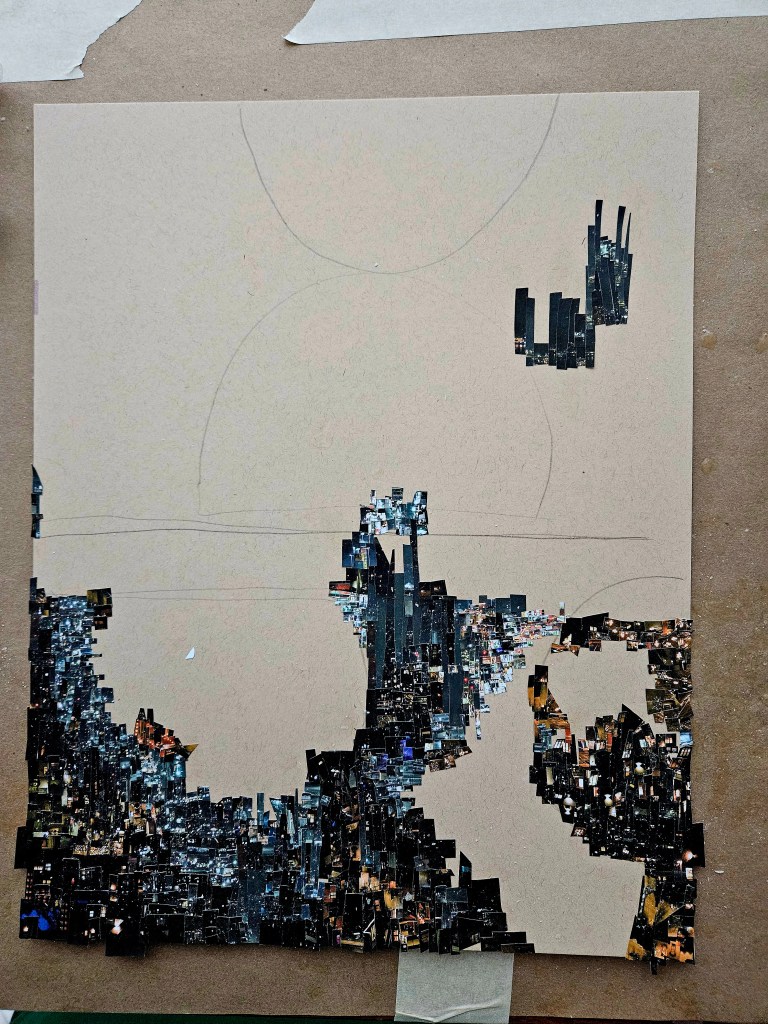
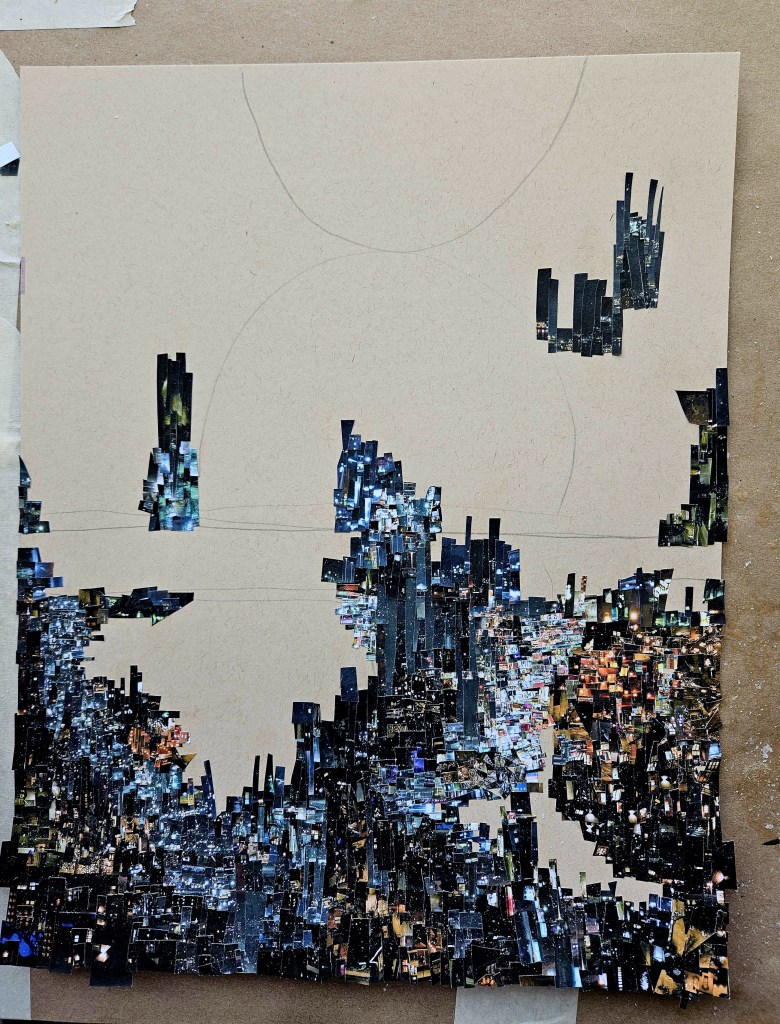
I cut up the photos into tiny, tiny pieces and they are carefully lain out on sheets. I look at the sheets as I work selecting what goes where in that moment. Do not ask me how i know, I just feel it, each selected piece seems right for where it is placed. The entire thing is very labor intensive, i see tiny paper snow flurries in my dreams often when halfway through a piece.

The work is copywritten and not for use without permission.
Northern Symphony

Finally finished my latest CINEFIELD®. Although it felt as if it took forever, I am very pleased and proud of the results.

The entire piece is from a single photo which I personally took and then printed up many times. I used my trusty pair of (tiny) scissors to cut out the pieces and then glued them to 11×17 piece of paper using adhesive and small brush.

My goal was to offer up a work that one could go back to many times and notice a new thing each time. I always have the design in mind beforehand but which piece I use where is completely discovered in the moment. I cut out sheets of tiny shapes which are arranged on a table by what will become the work. In this way you can look at all my complex CINEFIELD® as completely improvised.

(I’m the Charlie Parker of collage)

Northern Symphony 11×17 (C) Wayne Wolfson. Not for use without permission

Addendum: I used to live in a city that often had weekend “art walks” or art & wine block party type things. There would be kiosks for photographers etc who had “art” but each thing was reproduced hundreds of times and in various sizes. There is nothing wrong with this so long as you realize it is less buying art and far more in line with buying a postcard/poster/print.

I have CINEFIELD® prints available but each print is only done twice and one of the two is for my own archive. My site goes into all technical details. I have gotten emails asking what is available as the site currently only lists a few as available. If there is a Cini you are interested in get in touch with me, it could be that I just had not had prints made yet.

LuLu

Just finished my latest Cinefield®. This is the most rhythmically complex piece I have done. I am very pleased with the results.

The piece is 11×17 inches. As is always the case, the images are only from photos which I personally took. I used the traditional method of my tiny, trusty scissors and adhesive applied with a brush.

(C) Wayne Wolfson. Not for use without permission

Cinefield® Miles

For all my work, I’ve always had two main goals. To develop a discernable voice and to create works which in some manner effect the viewer. The first was achieved via lots of sweat and singular concentration, while the second will be a life-long mission.

The problem with having a recognizable voice is that one can either unintentionally or out of laziness lapse into mere mannerisms. This is to be avoided at all costs. It is the motivation behind my constantly leaving my comfort zone and trying new things.

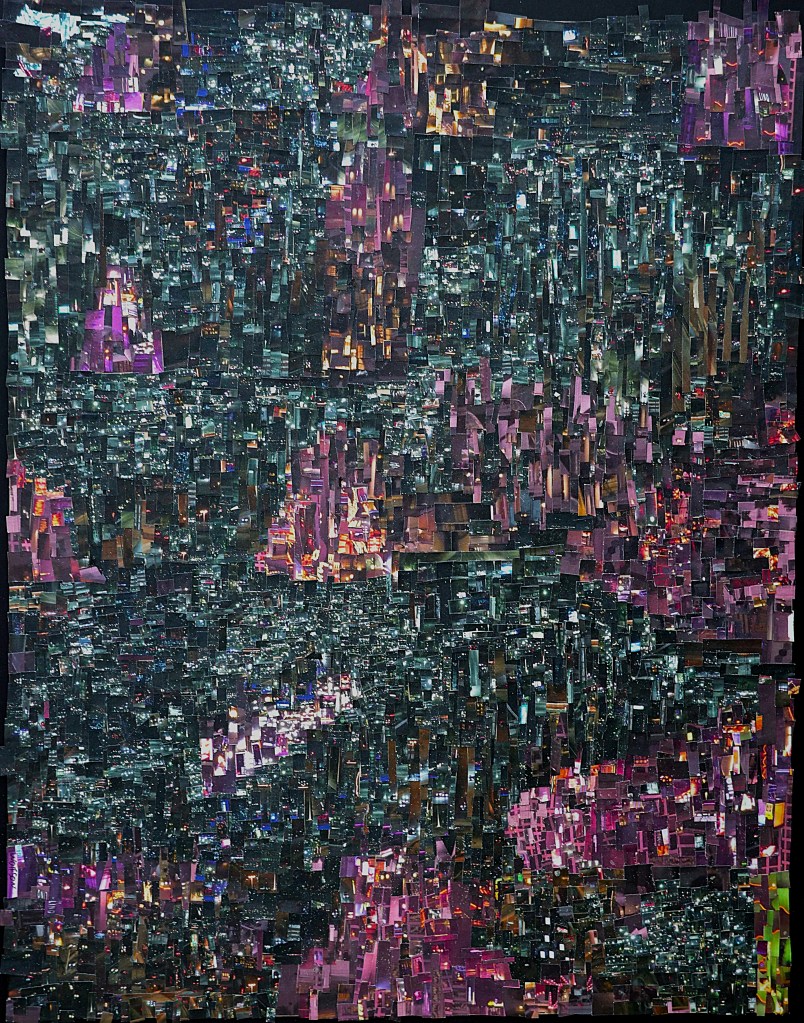
For Miles I sought to make it different than what had come previous. It can still be recognized as a sibling of the predecessors as the medium does to some extent effect the voice. The mission for this one was that I wanted the viewer to be able to go back multiple times and find new little moments occurring within to notice.

As is always the case with these works, I only use photos which I personally took. For this piece, I was fortunate to find an area which was trying to entice night people with entire buildings being lit up in purples and pinks. These colors being new to my Cini palette were a great way to further the newness I was trying to achieve. I would combine an overall different color palette with an increased rhythmic complexity.

There is no digital magic, I used my trusty scissors to cut out tiny pieces and a brush for adhesive. The piece is 11×17 inches.

I always have a sort of soundtrack when I do Cinefield® pieces. I do not merely listen to same albums over and over, the soundtrack is what i start out with and as the day goes on other things are put on. They serve as an initial mood setter. This piece’s soundtrack:

Miles Davis Big fun

The Soft Pink Truth Is It going to Get Any deeper Than This

Bennie Maupin & Adam Rudolph Symphonic Tone Poem For Brother Yusef

Mozart (Rene Jacobs conducting) La Clemenza di Tito

(C) 2024 Wayne Wolfson not for use without permission

Cinefield® – Lotus

I just finished a new Cinefield®. It was labor intensive. A few things made this one different. I was on the road off and one again over the past few months. Normally I work on a Cini until I am done. This time I worked on it, hit the road, came back to it several times.

There was a definite apprehension about working on such a complex piece in this manner but it ended up stronger for it. The mini breaks allowed me to maintain level on concentration and intensity consistently.

The entire work is comprised from one photo which I personally took, reprinted over and over. I used my trusty scissors to hand cut each tiny piece using a brush to apply adhesive. The picture is 11×17 inches and there was no digital magic utilized.

It occurred to me only while working on this piece the nature of my Cini’s. I always have in my head beforehand the design and the effects/properties i.e this part will glow, here will be darker section etc etc. However, even as I am cutting out the tiny pieces, I do not know where they will ultimately go. It is only as I am laying a piece down that I know where I will put it. I look at each Cini as akin to a piece of music, so that makes the denser ones a sort of improvised symphony. Every Cini possesses the dichotomy of being super controlled while also improvised. It’s Charlie Parker & Schoenberg.

Lotus 11×17

A word about copyright & A.I:

A lot of my peers copyright a work only after a magazine/gallery, whatnot accepts the work. This is a big mistake, as soon as you post your work or submit it, first step in this process should be to copyright it. Generation instagram feels it a victimless crime to take what they want from the web for content beyond pics of them giving heart hands in some sunny local. There’s now plenty of examples too of artists having their works monetized by others . A copyright is not a forcefield, these things are still going to happen, but to have a copyright gives recourse should someone be using what you created without permission. It also makes having things taken down from sites/webpages far quicker too.

A.I is very misunderstood right now by many. It is not creating content so much as reconstituting things already on the web created by others. Whether it is literature or visual work and even music, it’s basically a super system which creates chimera based upon instructions. Most artists regardless of medium have some works online.

Copyright helps protect when your work goes into creating something without permission using this method.

Cinefield® Menage A T

There’s an old adage that money makes money. This saying is still parroted today but the meaning is mostly no longer known. If you are in sales and have a specific number which must be reached within a certain time frame, if lucky enough to reach it well ahead of schedule then most likely you will find yourself well over the number by the deadline.

Why? Because you are now relaxed, goal met. Time left on the clock, you can continue to sell with a casual mien which puts others at ease and prevents motives from being scrutinized.

Essentially, this is the power of wiggle room. Anytime you find yourself with no pressures of time frame or other matters of control, it facilitates a kind of ease in which things can get done.

Of course there’s many types of wiggle room, it’s far from restricted to a sales thing.

Currently, I find myself with wiggle room of no expectations of gallerists or other decision makers. This leaves me free to explore and stretch myself which suits me as I never want my work to become mere mannerisms.

I shake things up with what and how I create while I can. It’s a way to facilitate evolution too.

Most of my CINEFIELD® work is 11×17 inches. My last two I kept the size the same but set out with different goals for both, sort of challenges to myself. Wiggle room, wiggle room, I decided to keep the challenge method going.

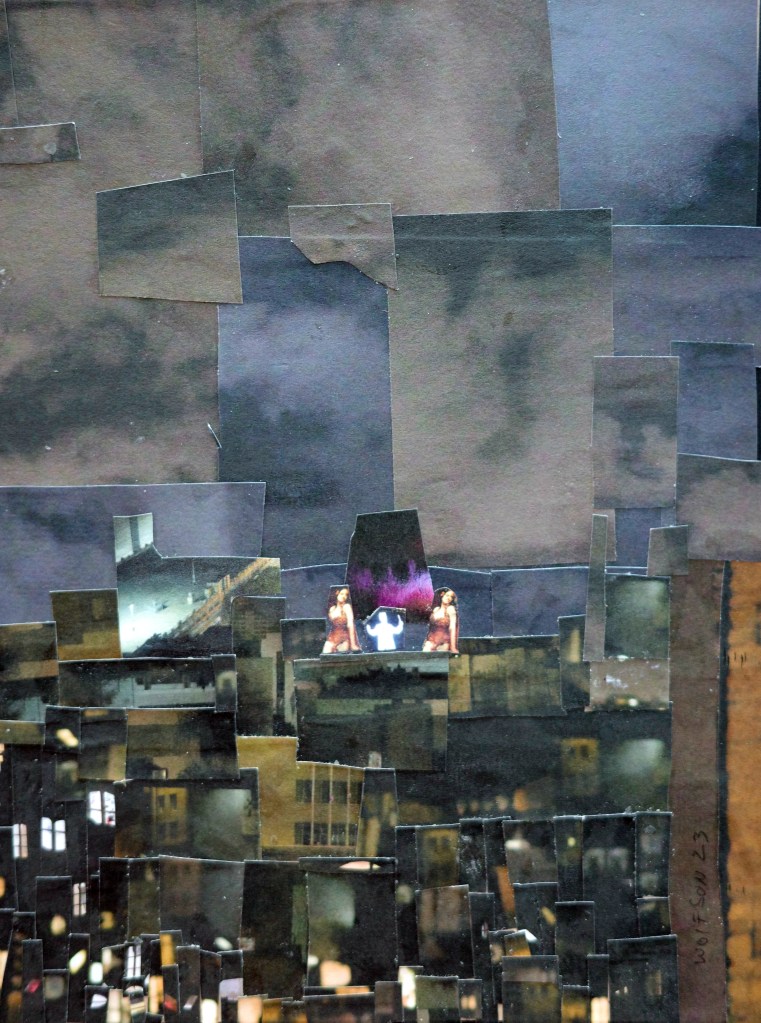
For this one, I decided to go much smaller 6×8 inches. Although I prefer a certain amount of density compositionally, I would eschew that too. I also decided to make this one more overtly narrative. Luminescent elements so much a large part of other pieces would be dropped down to a smattering in favor of a more limited, muted palette.

I was pleased with the results. This piece is very different from its siblings. As is always the case, the images used are all from photos which I personally took. I used no digital magic, only the traditional method of scissors and adhesive applied with a small brush.

CINEFIELD® Carousing

Often when you read a biography on artists, in any medium, I have noticed a commonality. There seems to be a career sweet spot. This is when they have established their voice, have an audience and can comfortably exist while serving the process. They are not necessarily as big as they will become.

What makes this the sweet spot is the ability to still 100% follow one’s own North Star. No consideration is given towards audience nor critic expectations. New directions can be taken, old ones dropped.

The tragedy of all of this is that this phase is often recognized by the artist only well after the fact.

I am lucky to recognize that I am in the sweet spot. With no forced upon restrictions nor expectations, I experiment. Even when it is a direction I decide not to go in, this freedom fosters evolution.
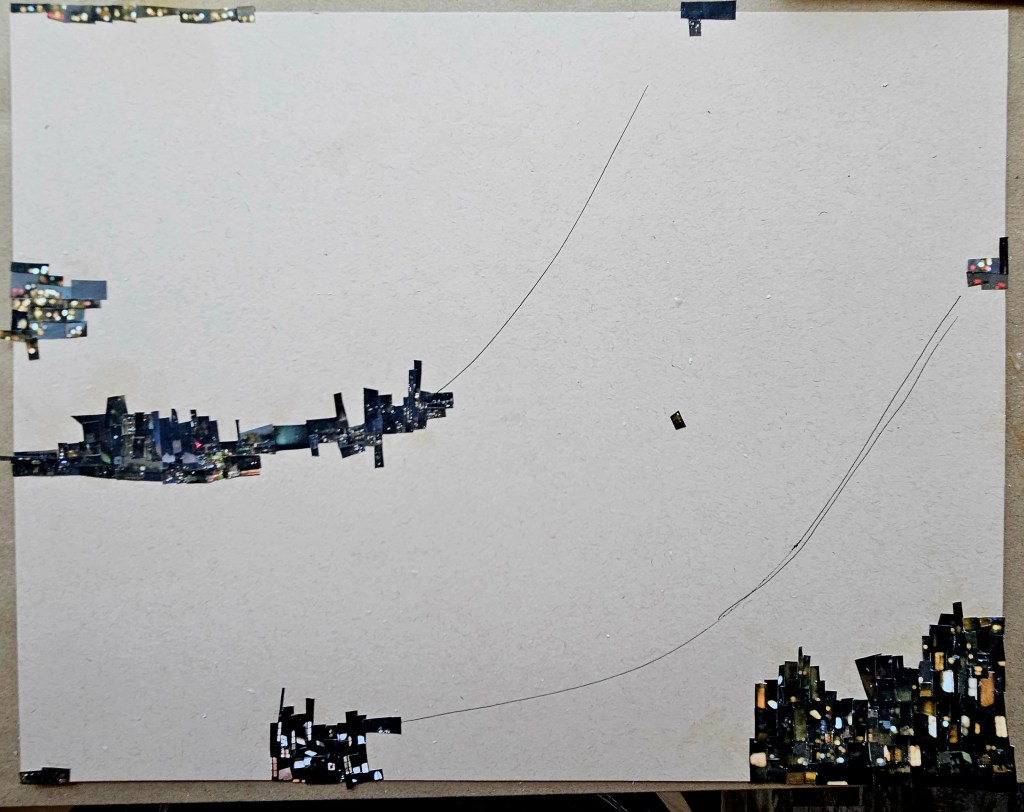
My last Cinefield®, I wanted to make more rhythmic than previous ones. With this one, I wanted a greater density. I went with a more limited color palette as to make it more noticeable. I tried several new things with this piece which will now just be part of my regular process.

With all my Cinefield® works, I only use photos which I personally took. Another different thing for this one, I only used two photos (in general with these works I don’t use too many, but this is even less). The piece is 11×17 inches. No digital magic just scissors and adhesive applied with a tiny brush.

Errata: copyright. People, especially with visual work, prominently display copyright notices. Definitely copyright your work, before you post it anywhere, before you submit it anywhere. However, the watermarks and notices are a distraction and according to many gallerists and editors I have spoken with, the mark of an amateur. To have the notice on edge of paper, it can be clipped off. To have giant watermark, your are wrecking effect of your piece.

Some might complain that to copyright everything one puts out can be cost prohibitive. With drawings, things where an artists hand is so blatantly present, it is not necessary. As for the rest, it actually makes an artist assess their work better. No one hits a bullseye each and every time. If you are considering copyrighting a work w/its accompanying fee, you have to be more honest with yourself.

Copyright is not a forcefield which will prevent people from lifting an image you created. It gives you a quick recourse to take back what is yours. Generation Instagram feels that if it is online and they like it, it’s a victimless crime to use it as content. Copyright allows you to get it back quicker or really drop the hammer should someone actually be monetizing one of your creations.

Blinky

There was a slight gap of time between my Cinefields® . As much as I enjoy them, they are very time consuming and when in the process of creating them, they dominate my studio space.

For what would be the last one before returning to Europe, I wanted to stretch myself. I only used two photos which I knew would limit the color palette.

Not necessarily apparent, this is my most rhythmically complex piece. I wanted to present flowers of light. Vast unfurling urban fields for people to look at and do their own journeys.

As is always the case, I only used photos which I personally took. There is no digital magic, I used the traditional method of scissors and adhesive applied with a brush.

Blinky 11×14 (The photos do not give the sense of it, but each piece is tiny!)

Errata: There has been much talk of artificially created art. This, along with fact generation Instagram does not feel taking work they find online for their own content/page a crime, makes copywriting one’s work more important than ever. However, most gallerists, agents and collectors I talk to all feel to emblazon a work w/ copyright notice is mark of amateur. It also ruins the work. If someone wants to “borrow” your work, they are just going to crop the notice off or sometimes not even that. Then why copyright? Because it gives you quick recourse for when you do find someone using your work. I am not blasé about my work being taken, of course it’s upsetting but that notice is no deterrent. It will make whomever react quicker when you come across your work out there somewhere. It’s worth paying the fee, filling out the forms.

CINEFIELD® – For Ron Carter

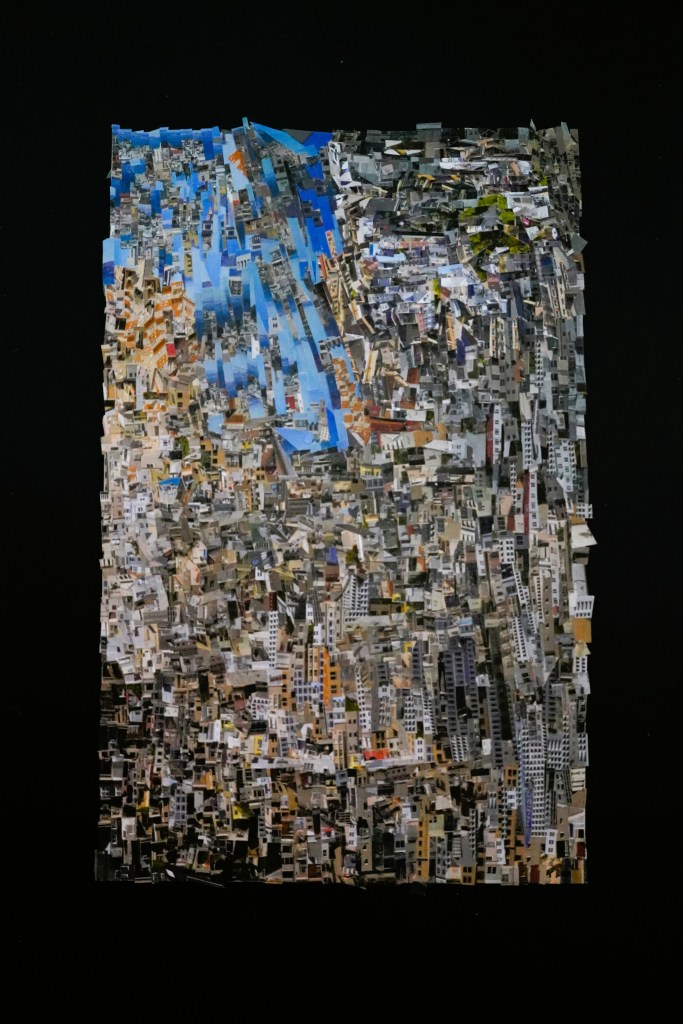
Long have I been a fan of Mondrian. My library is full of many books on his work. He would arrange the orientation of some of his canvas in a diamond shape. The work was done with this in mind and it was more than merely going for an unorthodox positioning, the shape was part of the tension and release for the pieces.
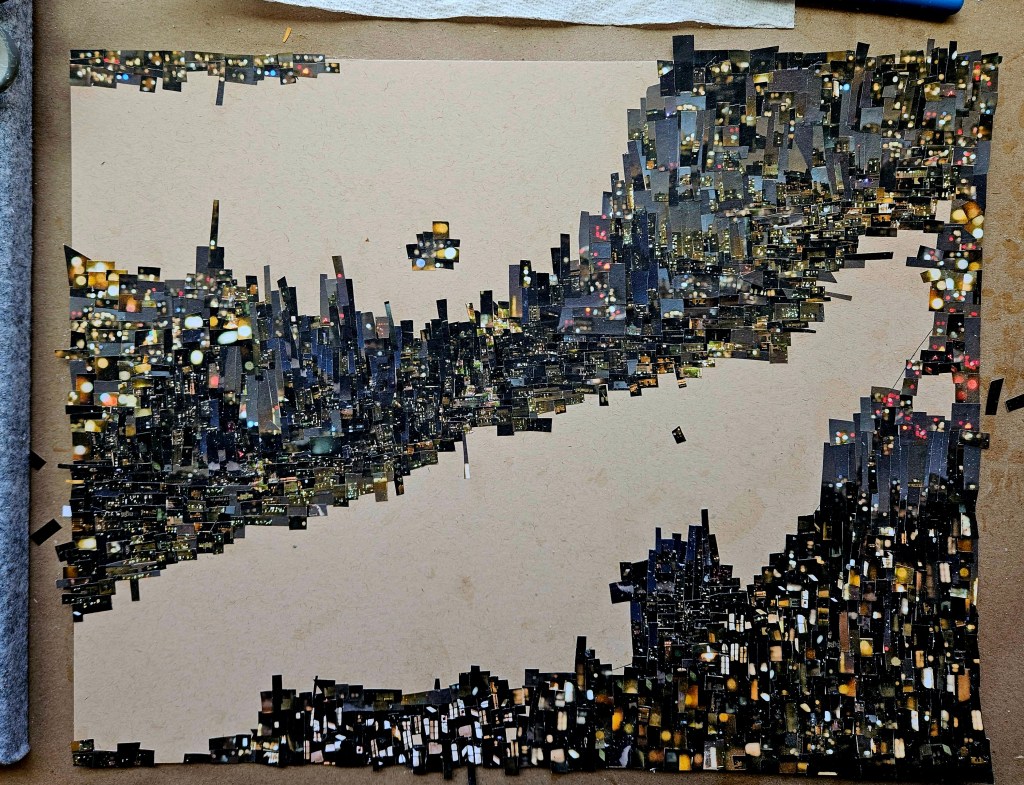
I decided to challenge myself, doing my version of this. I cut down a piece of heavy tan multi-media paper to a different shape for me. It was not mere arbitrary move though, I had in mind before starting the rhythm of the piece. To facilitate further evolution, I had in mind to make this cityscape a day time scene since most of my others pulse with a nighttime luminescence.

For a longtime I have been a fan of Ron Carter. There is a new documentary Ron Carter: Finding the Right Notes . It is well worth seeing. It shows a man whose lifetime devotion and joy is in serving the process. At a time that I was being pulled in all different directions, it served as the perfect reminder of what’s important.

As is always the case, all the photos used for this were taken by myself. There is no digital magic, I used traditional method of scissors and adhesive applied with a brush.