CINEFIELD® Carousing

Often when you read a biography on artists, in any medium, I have noticed a commonality. There seems to be a career sweet spot. This is when they have established their voice, have an audience and can comfortably exist while serving the process. They are not necessarily as big as they will become.

What makes this the sweet spot is the ability to still 100% follow one’s own North Star. No consideration is given towards audience nor critic expectations. New directions can be taken, old ones dropped.

The tragedy of all of this is that this phase is often recognized by the artist only well after the fact.

I am lucky to recognize that I am in the sweet spot. With no forced upon restrictions nor expectations, I experiment. Even when it is a direction I decide not to go in, this freedom fosters evolution.

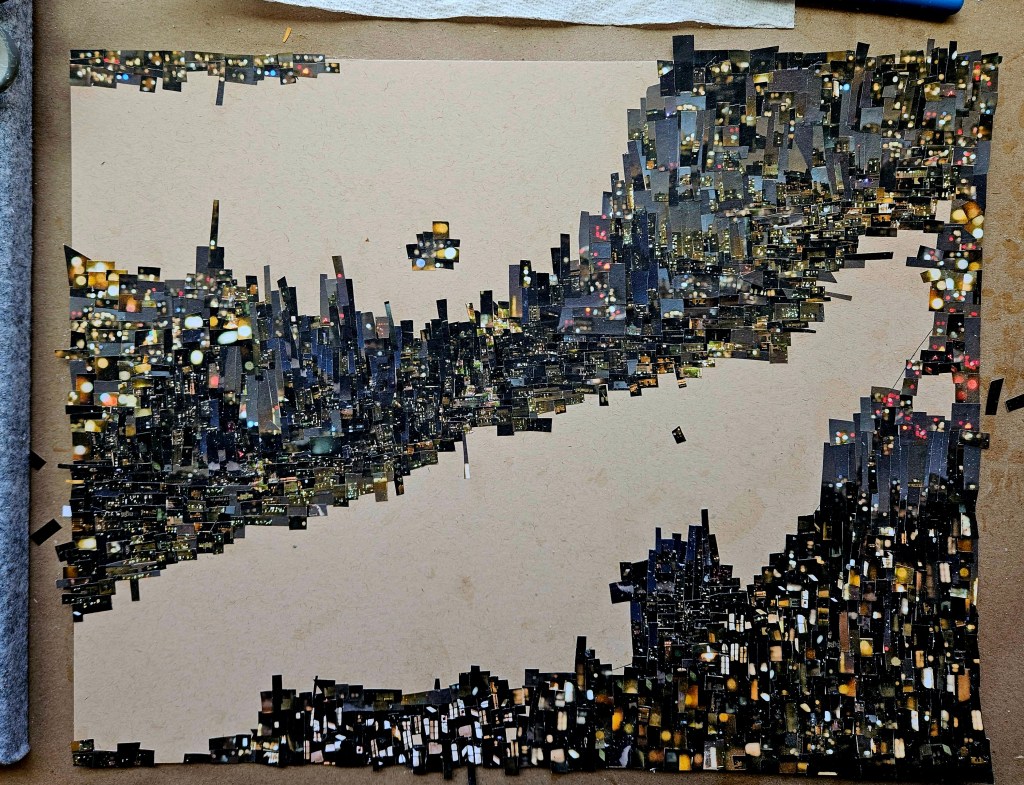
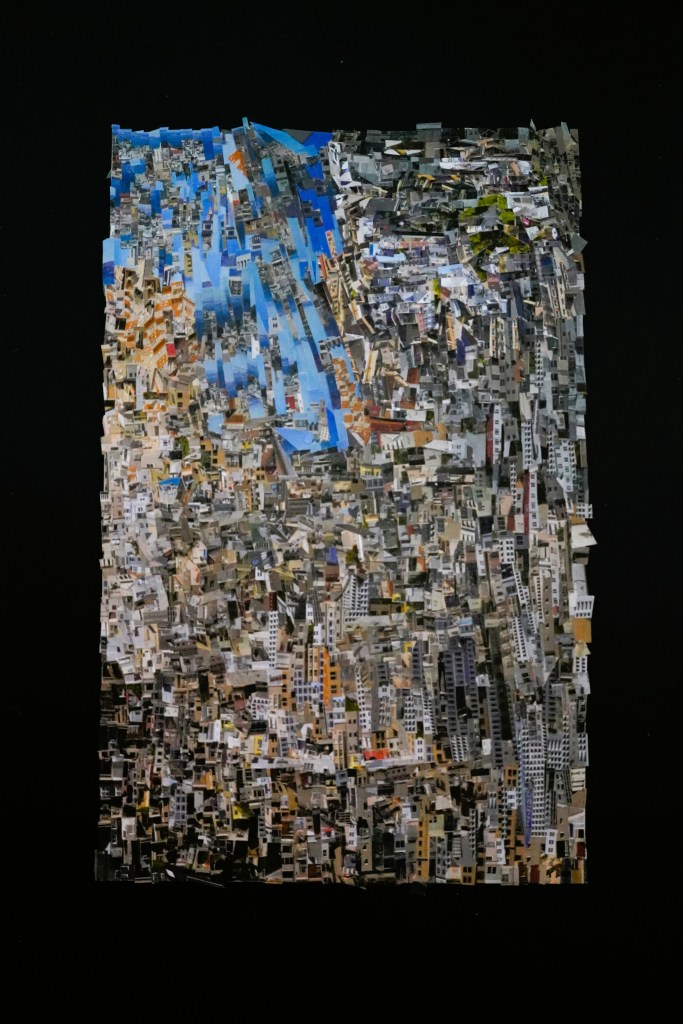
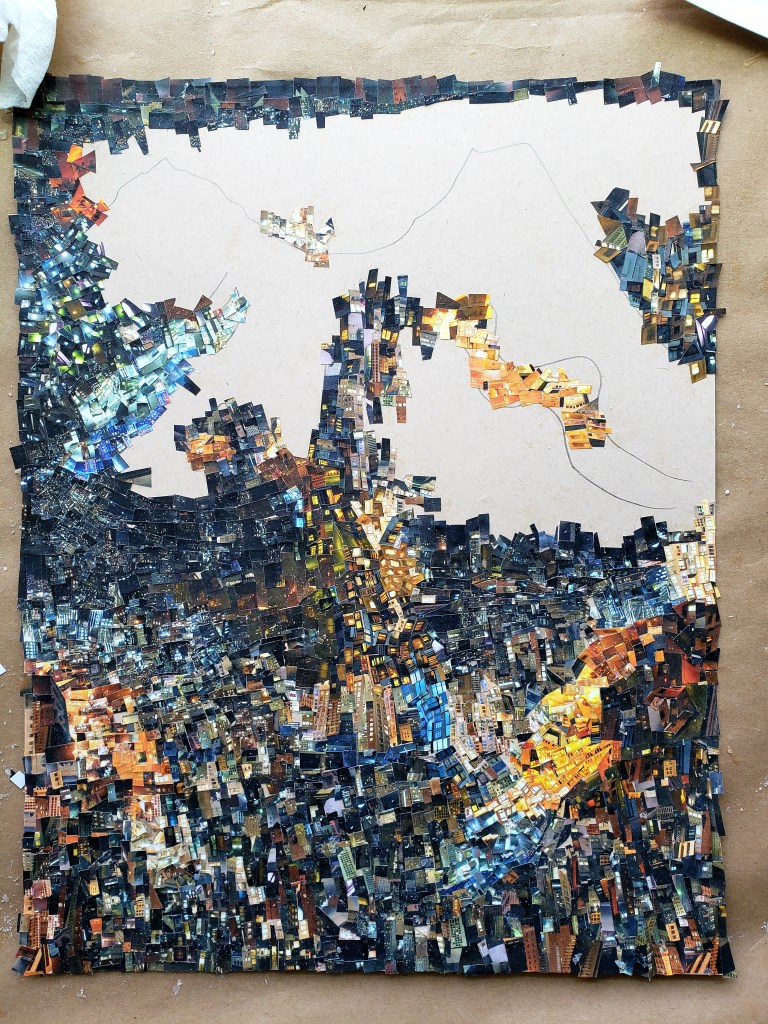
My last Cinefield®, I wanted to make more rhythmic than previous ones. With this one, I wanted a greater density. I went with a more limited color palette as to make it more noticeable. I tried several new things with this piece which will now just be part of my regular process.

With all my Cinefield® works, I only use photos which I personally took. Another different thing for this one, I only used two photos (in general with these works I don’t use too many, but this is even less). The piece is 11×17 inches. No digital magic just scissors and adhesive applied with a tiny brush.
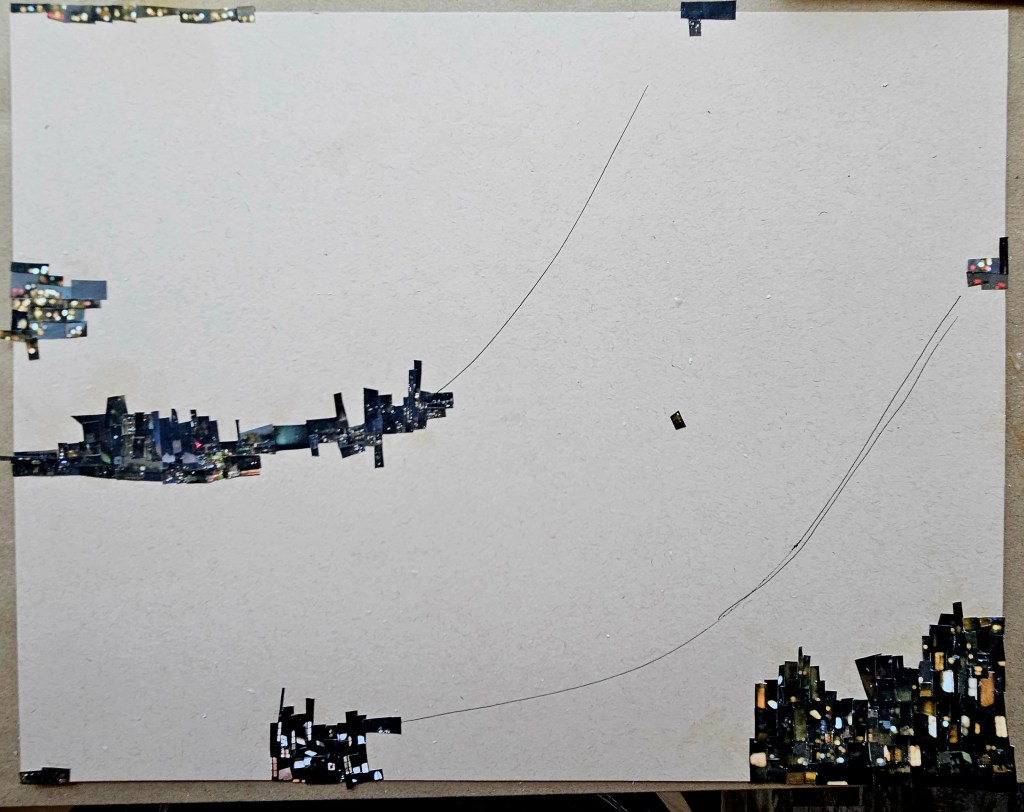
Errata: copyright. People, especially with visual work, prominently display copyright notices. Definitely copyright your work, before you post it anywhere, before you submit it anywhere. However, the watermarks and notices are a distraction and according to many gallerists and editors I have spoken with, the mark of an amateur. To have the notice on edge of paper, it can be clipped off. To have giant watermark, your are wrecking effect of your piece.

Some might complain that to copyright everything one puts out can be cost prohibitive. With drawings, things where an artists hand is so blatantly present, it is not necessary. As for the rest, it actually makes an artist assess their work better. No one hits a bullseye each and every time. If you are considering copyrighting a work w/its accompanying fee, you have to be more honest with yourself.

Copyright is not a forcefield which will prevent people from lifting an image you created. It gives you a quick recourse to take back what is yours. Generation Instagram feels that if it is online and they like it, it’s a victimless crime to use it as content. Copyright allows you to get it back quicker or really drop the hammer should someone actually be monetizing one of your creations.

Blinky

There was a slight gap of time between my Cinefields® . As much as I enjoy them, they are very time consuming and when in the process of creating them, they dominate my studio space.

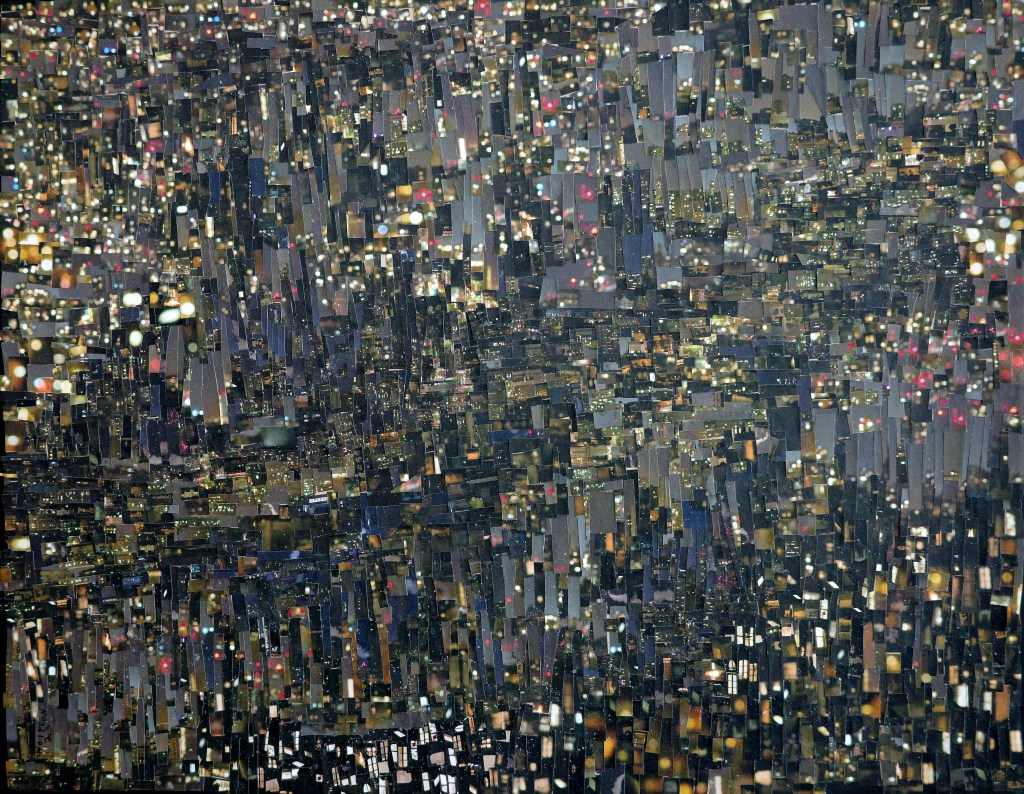
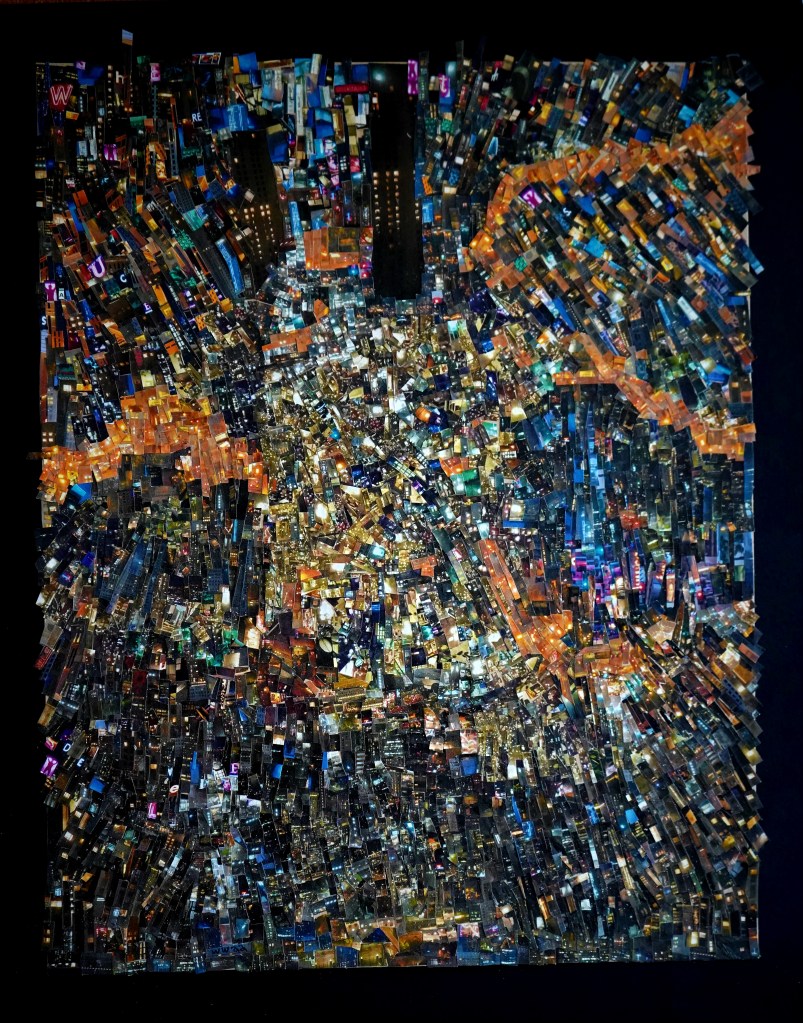
For what would be the last one before returning to Europe, I wanted to stretch myself. I only used two photos which I knew would limit the color palette.

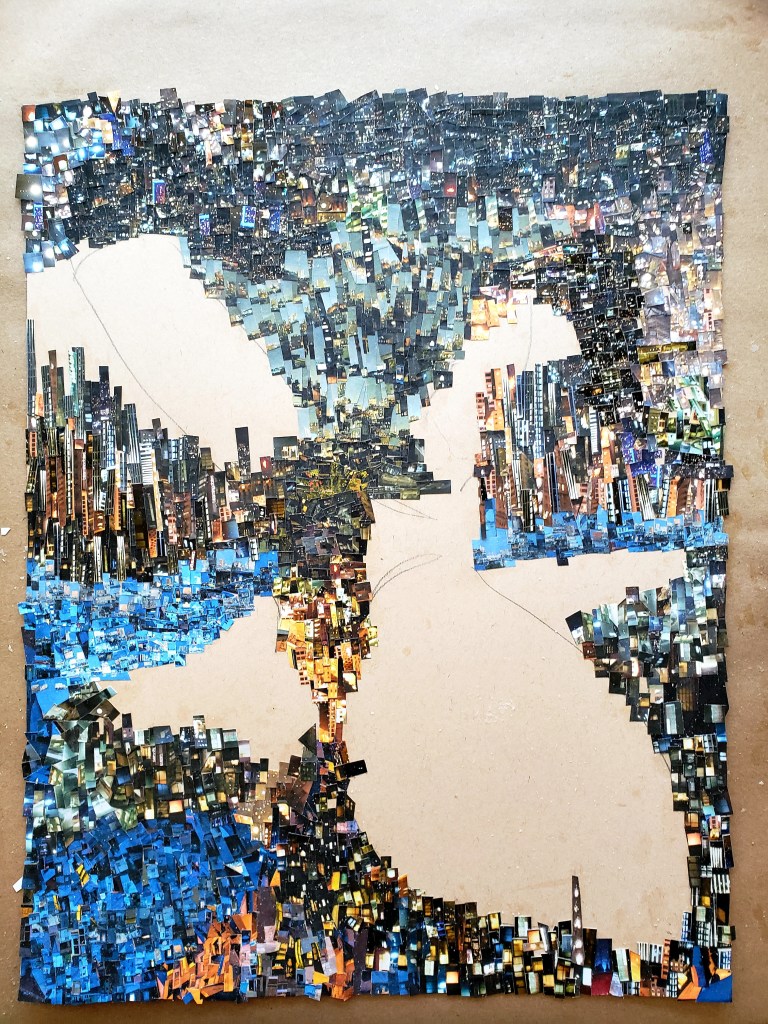
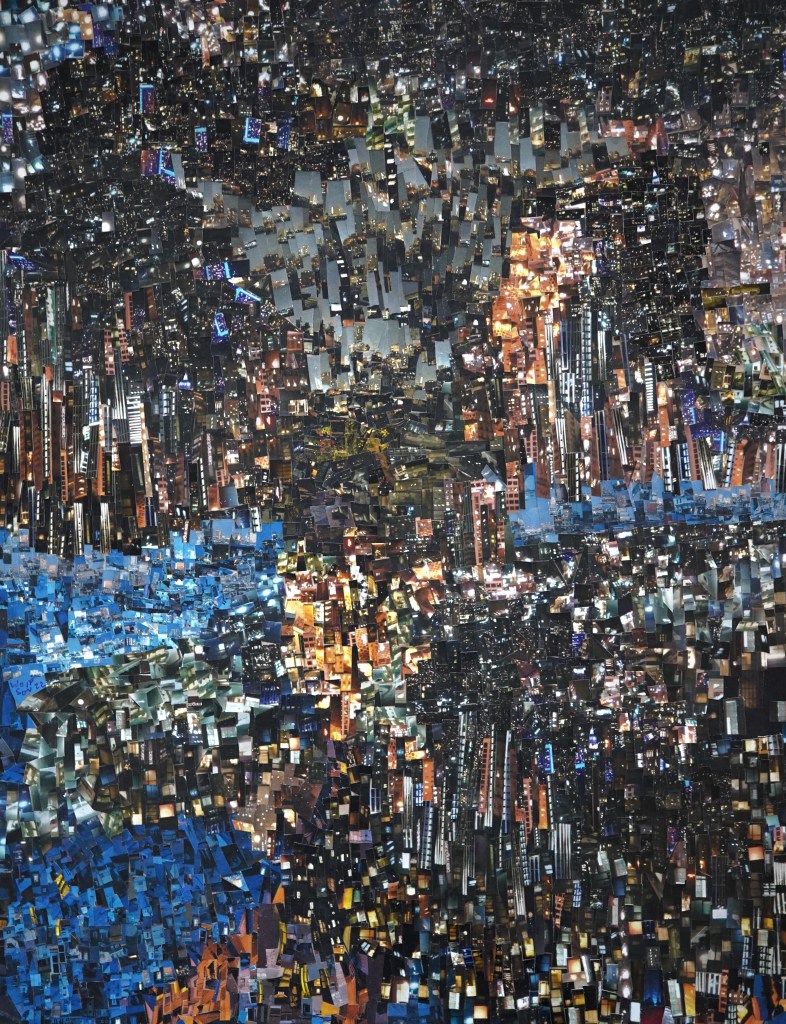
Not necessarily apparent, this is my most rhythmically complex piece. I wanted to present flowers of light. Vast unfurling urban fields for people to look at and do their own journeys.

As is always the case, I only used photos which I personally took. There is no digital magic, I used the traditional method of scissors and adhesive applied with a brush.

Blinky 11×14 (The photos do not give the sense of it, but each piece is tiny!)

Errata: There has been much talk of artificially created art. This, along with fact generation Instagram does not feel taking work they find online for their own content/page a crime, makes copywriting one’s work more important than ever. However, most gallerists, agents and collectors I talk to all feel to emblazon a work w/ copyright notice is mark of amateur. It also ruins the work. If someone wants to “borrow” your work, they are just going to crop the notice off or sometimes not even that. Then why copyright? Because it gives you quick recourse for when you do find someone using your work. I am not blasé about my work being taken, of course it’s upsetting but that notice is no deterrent. It will make whomever react quicker when you come across your work out there somewhere. It’s worth paying the fee, filling out the forms.

CINEFIELD® – For Ron Carter

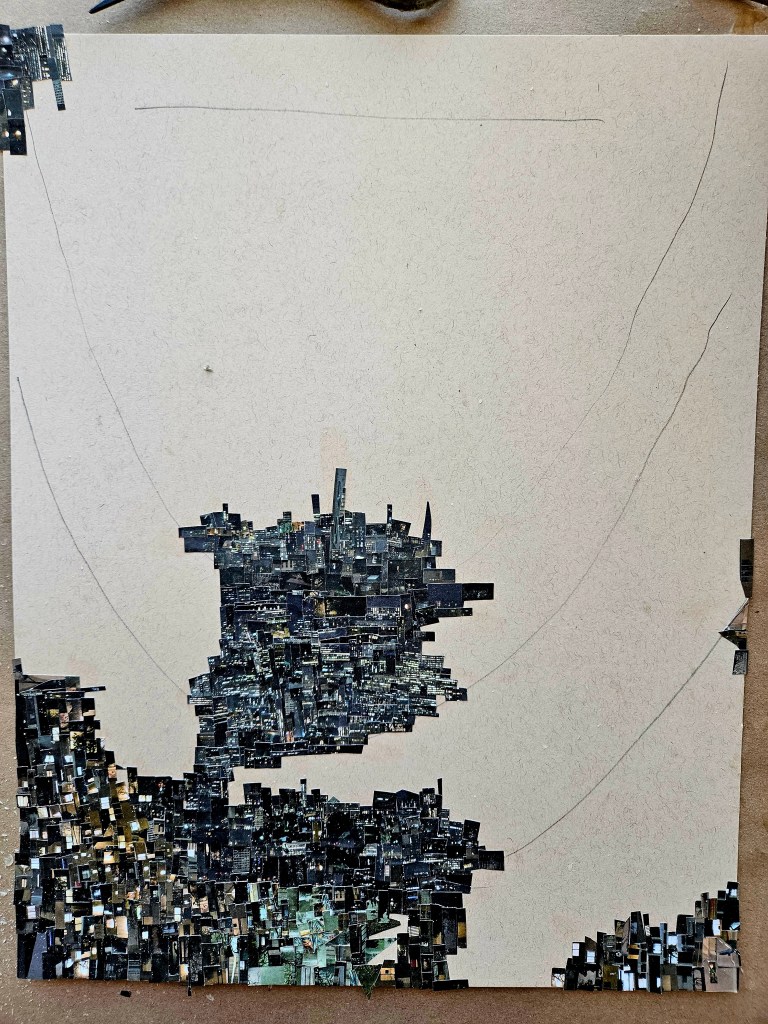
Long have I been a fan of Mondrian. My library is full of many books on his work. He would arrange the orientation of some of his canvas in a diamond shape. The work was done with this in mind and it was more than merely going for an unorthodox positioning, the shape was part of the tension and release for the pieces.

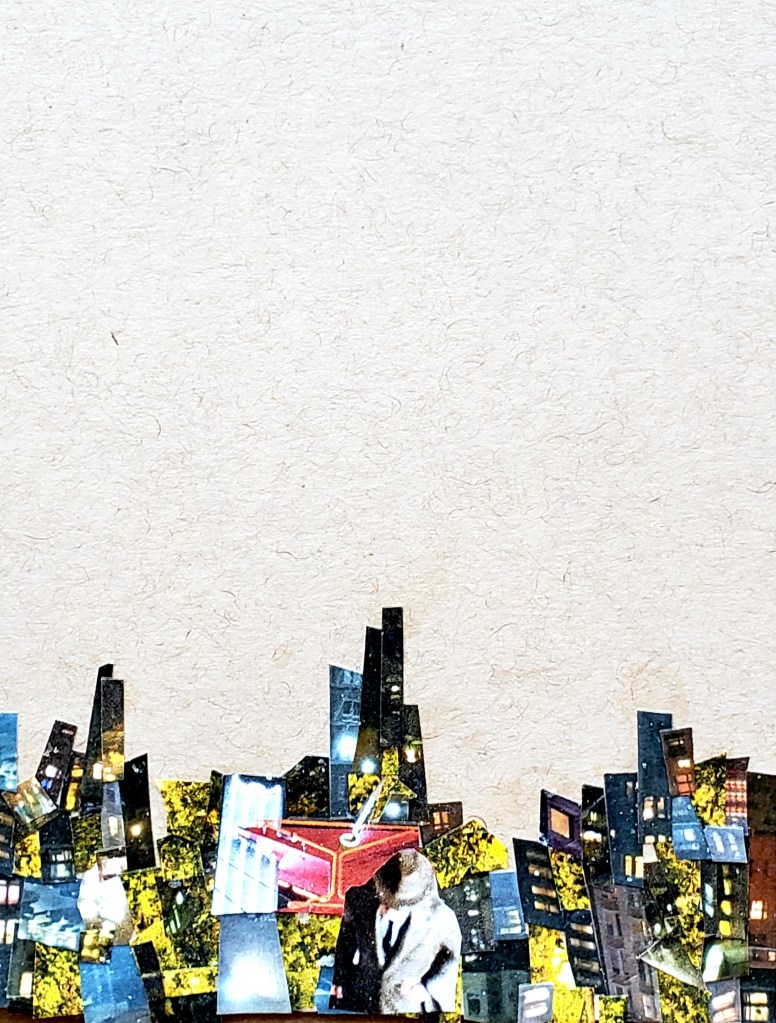
I decided to challenge myself, doing my version of this. I cut down a piece of heavy tan multi-media paper to a different shape for me. It was not mere arbitrary move though, I had in mind before starting the rhythm of the piece. To facilitate further evolution, I had in mind to make this cityscape a day time scene since most of my others pulse with a nighttime luminescence.

For a longtime I have been a fan of Ron Carter. There is a new documentary Ron Carter: Finding the Right Notes . It is well worth seeing. It shows a man whose lifetime devotion and joy is in serving the process. At a time that I was being pulled in all different directions, it served as the perfect reminder of what’s important.

As is always the case, all the photos used for this were taken by myself. There is no digital magic, I used traditional method of scissors and adhesive applied with a brush.

Female of the Species

My sculptures are an acquired taste, which I am fine with. The personal appeal of then for me is in their looseness. Unlike my other visual mediums, there is a large component of improvisation to them. Materials help dictate composition.

Currently I am in middle of two projects which are taking up the lion’ share of space in my studio. I can not start a new Cinefield®. I do miss process. I knew that I could do a regular collage and it would not encroach upon other things going on space & time wise.

This is a collage, not Cinefield® because unlike the later, I did not create the base images. Rarely now do I work in the medium of collage utilizing images not from pictures which I personally took. Like my sculptures, this gave me the same pleasure derived from loose improvisation. This rare occurrence of using other’s images is akin to jazz great playing a standard, someone else’s melody providing the frame work for their voice to flow.

The piece is 7×10 inches. No digital magic just scissors & adhesive applied with a brush.

Female of the Species

It is not often that I mention things of mine available for purchase. I have teamed up with a great framer & photo lab to produce a series of extremely limited edition Cinefield® prints. The info can be found here. Once they are gone, that is it.

http://www.waynewolfson.com/works-for-sale

CINEFIELD® – Nocturne 10

I always have several things going on at once. Currently I am in the middle of finishing a big project (full length novel) while about to start several others. My CINEFIELD® work tends to start to sprawl across my studio. And despite now vacuuming/sweeping daily when working on one, there is still paper confetti snow flurries and sheets of tiny pieces waiting to be used that find their way onto every available surface.

There is a great pleasure in my working in this medium. Mess aside, they are also very time consuming. I don’t want too long a time to go by without doing a piece as, like all my other mediums, it’s very much become a part of me.

The solution was to do a smaller piece which makes far less mess. Surprisingly though, smaller pieces are more difficult because the already tiny components must be even smaller. And the smaller general area means far less space to create sense of tension and release. (I equate this aspect to way back in the day, early vinyl had technical limitations, so the average record time wise, was shorter than later. Because of this, great jazz soloists, when doing their thing had to take far shorter solos than during the Long Playing era. This limitation forced all the greats to learn to make their statements within the confines of the medium’s limits.) I am always up for a challenge as I feel it facilitates evolution.

Like all my works, ever image used was from photos which I personally took. There is no digital magic, I use scissors & adhesive applied with a brush. The piece is 2×4 inches.

Free Advice: Aside from blogs, most people are on one if not all other social media sites. Adding to the non-stop stream of Twitter. Instagram etc. are new posts from whomever one follows. If a minimum of 500 people are being followed and they are posting every day, when combined with everything else one has going on digitally, it reduces what could be meaningful content (learning something new, interactions etc.) down to white noise babble.

If you are an artist/anything in the arts, then the goal should be interaction, creating an audience who will be curious to what you do next. If you want to exchange ideas/interact, in general, this too will be hindered by the deluge.

Even some of the better blogs would benefit from posting less frequently.

Last time I posted this idea, people got defensive. There are only so many hours in the day a productive person can give to bowing their heads in prayer to the screen of their phone tablet. I am not commenting on anyone’s legitimacy but merely offering way to be a better, more effective blogger.

Cinefield® – Oohma Polumbo

When I started this Cinefield® I had decided to stretch myself as I had no deadlines. I work no digital magic on my pieces, but the photos I use are of course kept on my computer. Being a little under quarter of the way done with the piece my computer of seven years gave up the ghost.

I wanted to research what best option was for new one as unlike last time i bought one, I had concrete ideas of what I was going to use it for and what I did not need it to do. The research was the first delay. Once I determined what I wanted, it would take about two months for them to make it for me. I cleaned up the paper chad snowdrifts, switched to painting and some of my other visual projects.

As I was not merely sitting on my hands waiting, I did not mind. My third delay, the computer showed up and upon getting it set up, my equally old printer died. The amount of work she had done for me (ships & printers are always referred to in feminine form) made it not so shocking. I had already been looking at new printers anyways. Knowing ahead of time what I wanted and needed made the wait for a new one shorter.

The printer I got is geared towards photo film too. I bought few different types to experiment with while working to finally finish this piece. I was curious if I would be prevented from getting the flush edged fit as happens with my pocket printer mini-cinis. That film is akin to instamatic camera film, this is not, so I am able get the flush fit.

Aside from trying for more diverse color palette a few things made this piece different. The components consists of the paper on the old printer I always used, new printer with different type paper and three types photographic paper also from new printer. It was very different for me too in that I have never put down a Cinefield® for more than a day or so. The extended time away from it was totally new experience for me.

As is always the case, all the images are from photos I personally took. I use my tiny trusty scissors and adhesive applied with glue. The piece is 11×17 inches.

Cinefield® Metal Waves

I had been about a quarter of the way through a full sized Cinefield® when my computer gave up the ghost. This meant I couldn’t use my printer, needed for components. I Switched to doing a painting. The computer I ordered taking it’s time to get to me. I missed doing Cinefield® work

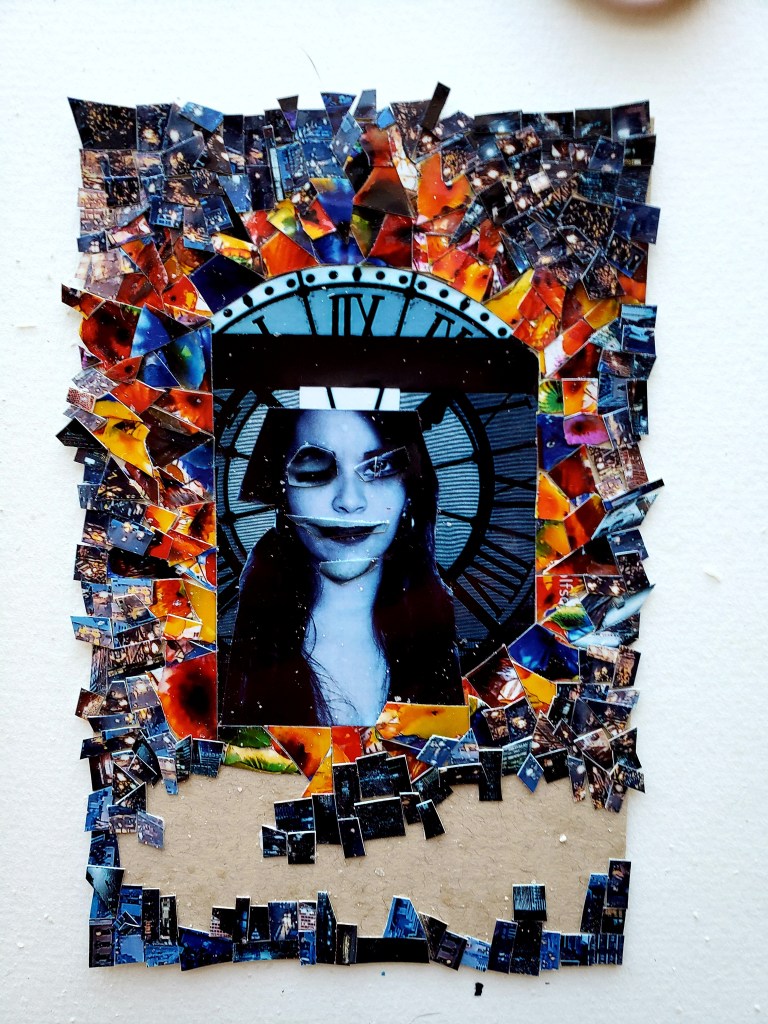
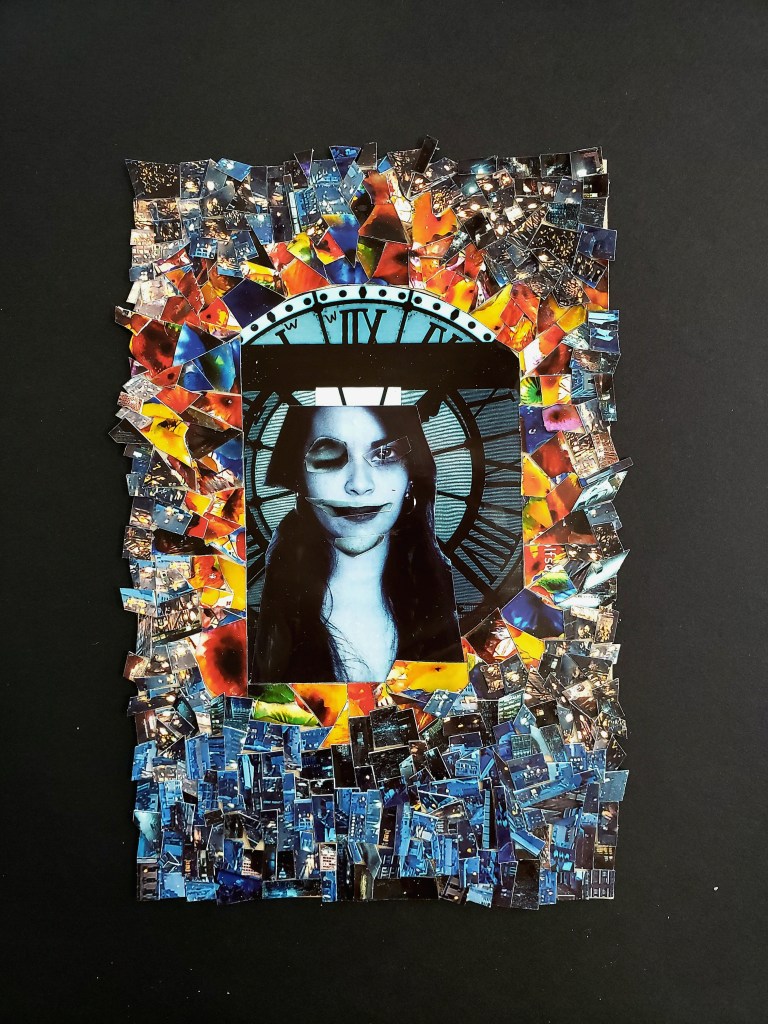
I decided to use my pocket printer and do a smaller piece. Having the luxury of no deadline and no expectations of a collector, I decided to try some new things:

I inserted an In the Eights figure into the work (female figure for those not familiar with my 8’s project)

The pictures are printed on thicker, instant film like paper. When I initially was figuring out methodology with these materials, I used my regular adhesive. If that comes in contact with picture side of the film, it immediately clouds it. I Switched to glue sticks. Problem with that was that it secures the pieces only temporarily. Often times I would lay a piece down only to have a different piece fly off. For this piece I used regular adhesive, applied with a tiny brush as to control it. The tricky part was that I had to lay each piece exactly where it was meant to go because of the adhesive. A piece lain wrong I might be able to pick up but then adhesive had touched other parts.

The nature of pocket printer pieces is they are thicker and rigid so it’s an impossibility to get the pieces flat and flush. The visible seams/edge are part of the look.

The piece is 4×4 inches. All the photos are by me except the female photo which was done for me. The clock image is from photo I took of Orsay Museum clock in Paris.

Cinefield® – Kini (Blue is Cool)

About to head back to Europe shortly. I had previously written about being able to utilize a pocket printer as to be able to do Cinefield® pieces in my Paris studio. As I live right around many great art supply stores i am sure that I will be able to find adhesive. However, I have never been one to leave things to chance. So i have been experimenting with glues which i can bring with me and are not as outright industrial as my adhesive.

The nature of my pocket printer pieces is that they are small, index card sized at most, 4×5. The first one I did, I tried a liquid glue stick of Elmer’s glue. This wasn’t ideal as when it got on the front side of image it caused discoloration. Also it was so liquid-y that there was no way to really control it despite the fact it was in a pen like delivery system.

In an absolute pinch I could have made due. My final attempt was with the glue sticks with which school children work. This took a bit of learning curve as pieces and sometimes entire sections after the fact would pop off making a brief snow flurry of cut pieces upon my table.

I got a handle on how to best utilize the glue stick, although it made everything more labor intensive. The good thing about it is that I can easily pack a glue stick in luggage w/no hassle from TSA.

There is very little chance though, because of the nature of the glue, that pieces I do would last. The photo I take of the finished piece will be the work/the art. I can’t fully explain why, but there is a freedom in this.

Of course it may be non issue as I find my preferred adhesive once moved back in.

Like all my Cinefield® work, every image is from photos which I personally took. One can see more edge/line of each piece, that is the nature of using pocket printer. The printed material is akin to business card sized photos, there is the impossibility of seamless edge blending as i often achieve w/my regular paper pieces. this piece is roughly 4×4.

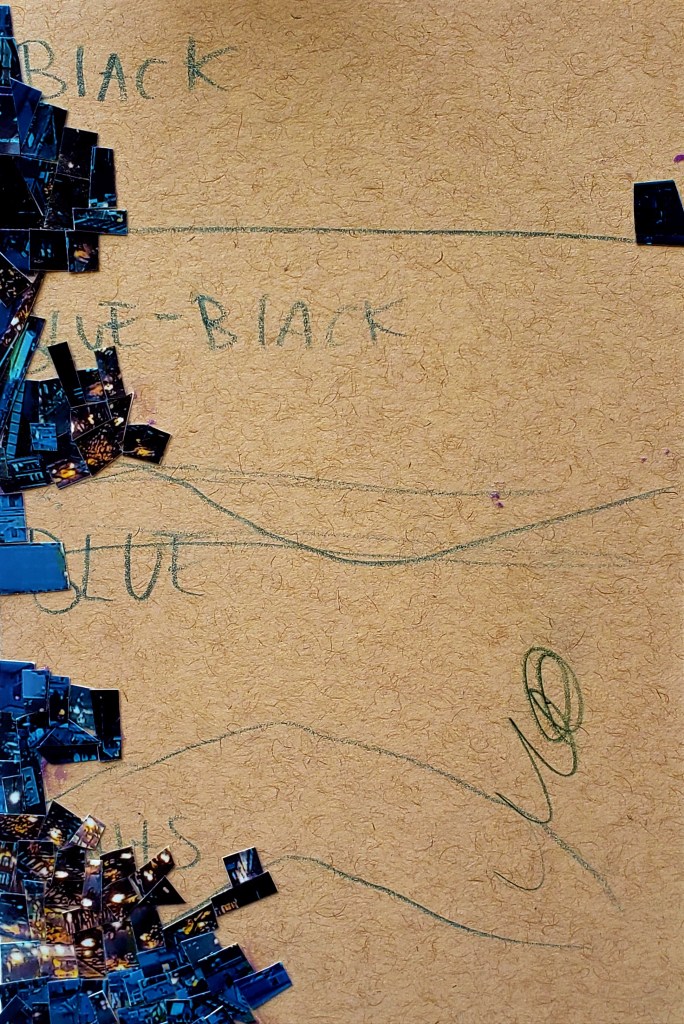
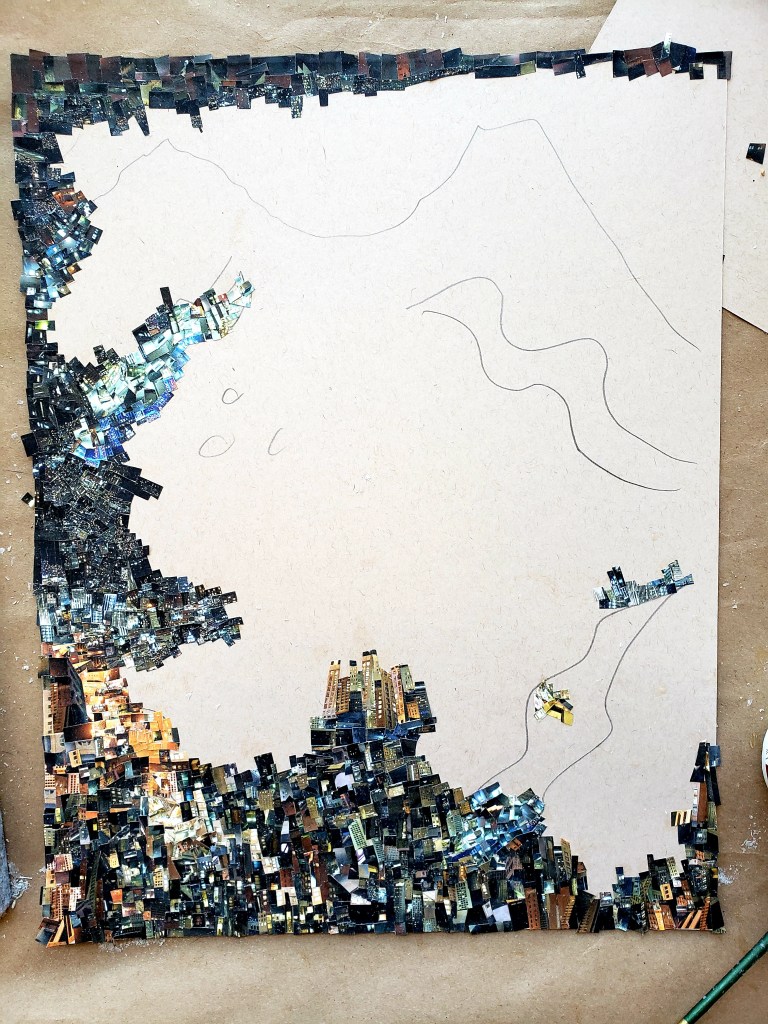
the highly technical schematic of the piece

Cinefield® We Are Romans

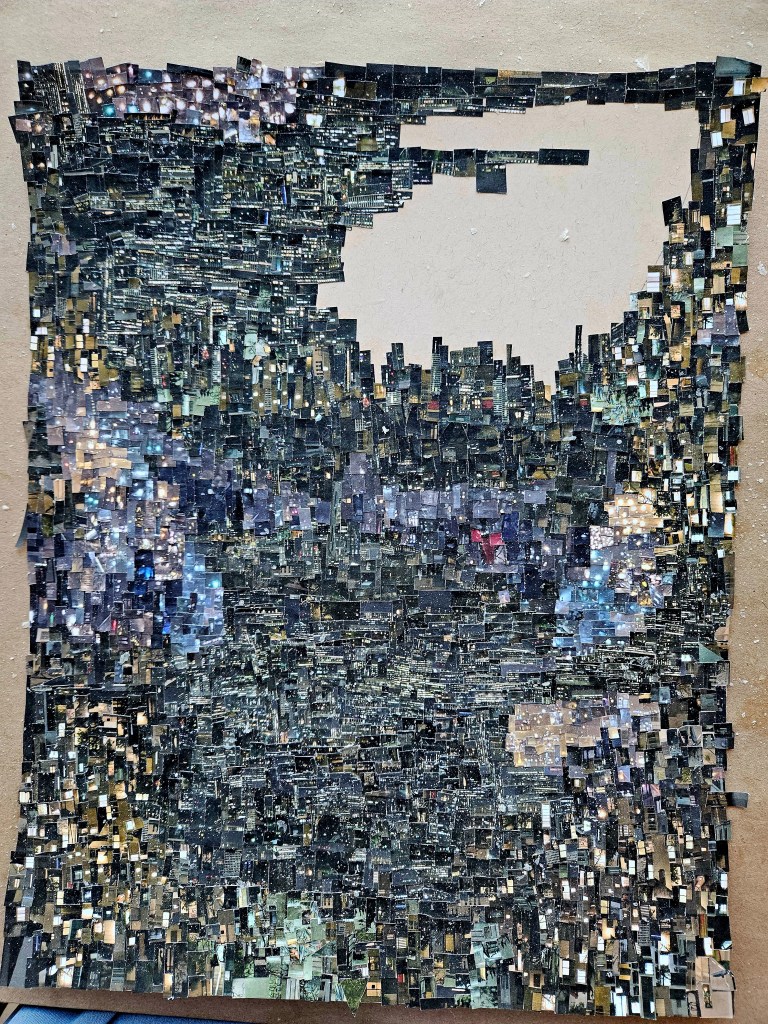
This was my most labor intensive piece. I am very fortunate to have the luxury of what I refer to as “wiggle room” which means no deadline, no audience or collector expectation. Untethered from these things, I can explore and evolve.

Regardless of how accomplished a finished Cinefield® ends up being, I always feel as if I have come away having learned something new. The desire to evolve and go one better as to best deliver an emotional payoff being my raison d’être.

This piece is 11×17. Like all my Cinefield® every i mage used are from photos which I personally took. There is no digital magic. I used the traditional method of scissors and adhesive applied with a brush.

We Are Romans

Limited Edition ‘Sauce

I am currently in the middle of finishing up a labor intensive full sized Cinefield®. My cover for the latest Funki Porcini album Where the Sauce is Deluxe has been as enthusiastically embraced as the album itself. I have received queries about whether the piece or prints of it are available for sale.

I am not ready to part with the original and my initial thought of prints of it made me worry of a loss of intensity, reducing down my work to becoming akin to something one would buy at IKEA et al.

I was presented with the idea of making one print only available to the public. this idea appealed to me as unlike with the current trend of NFTs, here was a work of art one could have and hold. Only doing one copy makes it so that one is not merely buying a slightly pricier, better quality poster.

Of course it would be nice for this piece to find a home but the other part of my motive for this posting is to save anyone with questions about the piece some time.

Here is all the pertinent information:

This piece was used as the album cover by Funki Porcini’s same-named album (2022).

All the images were from photos that I personally took. There was no digital magic/manipulation. I used the traditional technique of scissors & adhesive applied with a brush.

There will only be two prints of this made, one of which will remain uncirculated in my personal archives.

The technical specs are as follows:

– 24×30 inches Printed on Archival semi-matte photo paper 95 lb.

– Cold press mounted and Custom Framed with Museum Glass in a Black Metal Frame

Price: $2,500

Price includes shipping and insurance.

All payments made through Venmo in US Dollars

http://www.waynewolfson.com/works-for-sale